
Lace in the context of European fashion history – the 16th century
For five centuries, lace has been far more than just a decorative detail. It is a textile status symbol that reflects social hierarchies, political influence and the evolution of European fashion from the 16th to the 21st century. The series ‘Lace in Context’ tells the story of bobbin and needle lace.
The 16th century: the Renaissance, the Reformation and the visible self
During the Renaissance and the Reformation – an era of profound intellectual upheaval – fashion evolved into a tool for self-expression. The emerging, affluent middle classes used clothing to project their status, whilst the nobility employed it to reaffirm their identity. The fashion ideal of this period was that of a mature, dignified and stately personality. As research shows, the elite thus presented themselves in deliberate and unmistakable contrast to the common people [1].
Closely linked to this social change is the evolution of the shirt. Long established in the upper classes’ wardrobes, this undergarment first became visible in fashionable attire from around 1520. Made from the finest batiste and featuring a simple hem, it initially made only a subtle impression. Soon, however, the neckline and sleeves increasingly became the focus of design – the finely pleated cuffs established themselves as an integral part of upmarket clothing.
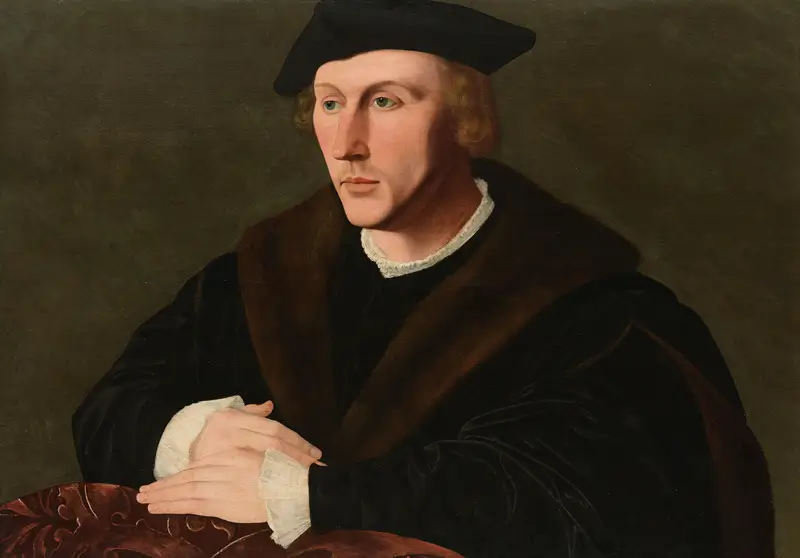
Around the neck, these folds develop into a small ruffle that extends over the doublet, gradually increasing in width and eventually becoming a separate garment detached from the shirt [2].
The deeper symbolism of white linen
It seems logical that this newly visible garment would call for some form of embellishment. Such decoration not only underlines the significance of the textile object, but also unmistakably emphasises the social status and importance of the person wearing it. The white shirt, made from purely plant-based linen or hemp, differs fundamentally from the animal-derived wool and silk of outer garments. Much like the white swaddling clothes of newborns and the shrouds of the deceased, the garment carries a spiritual message: it serves as a reminder that the human body is taken from the earth and returned to it. In the collective consciousness, the radiant whiteness of the visible shirt embodies the purity of the human being and the flawlessness of the soul [3].
The Development of the Ruff
The prosperity that prevailed in Europe – particularly in Italy – at the beginning of the 16th century, as well as the growing importance of self-expression, are reflected not only in high-quality clothing fabrics such as fine silk and wool. They are also evident in a wide variety of decorative elements such as embroidered ribbons, pearls, sequins and, ultimately, bobbin and needle lace. Costume historian Roberta Orsi Landini points out that this pronounced desire for embellishment not only had a decisive influence on the design development of lace, but also elevated it to the status of an exclusive luxury item in the first place. During this period, white linen lace – and, to an even greater extent, gold and silver lace – became the status symbol par excellence. Whilst white lace henceforth framed the face and hands, increasingly pushing the shirt’s original spiritual symbolism into the background, metal lace embodied pure material wealth [4].
Under the reign of the Habsburg Emperor Charles V, Spain rose to become a major European power, with the kingdom simultaneously becoming the continent’s leading fashion icon. Austere Spanish fashion promoted a three-dimensional, geometric silhouette, whilst black became the dominant colour in clothing. This characteristic triangular shape is found in both men’s and women’s clothing: the waist is cinched so tightly for both sexes that the upper body takes on the shape of an inverted cone. The floor-length women’s skirt forms the geometric counterpart to this and, in the same way, tapers downwards like a rigid, upright cone.
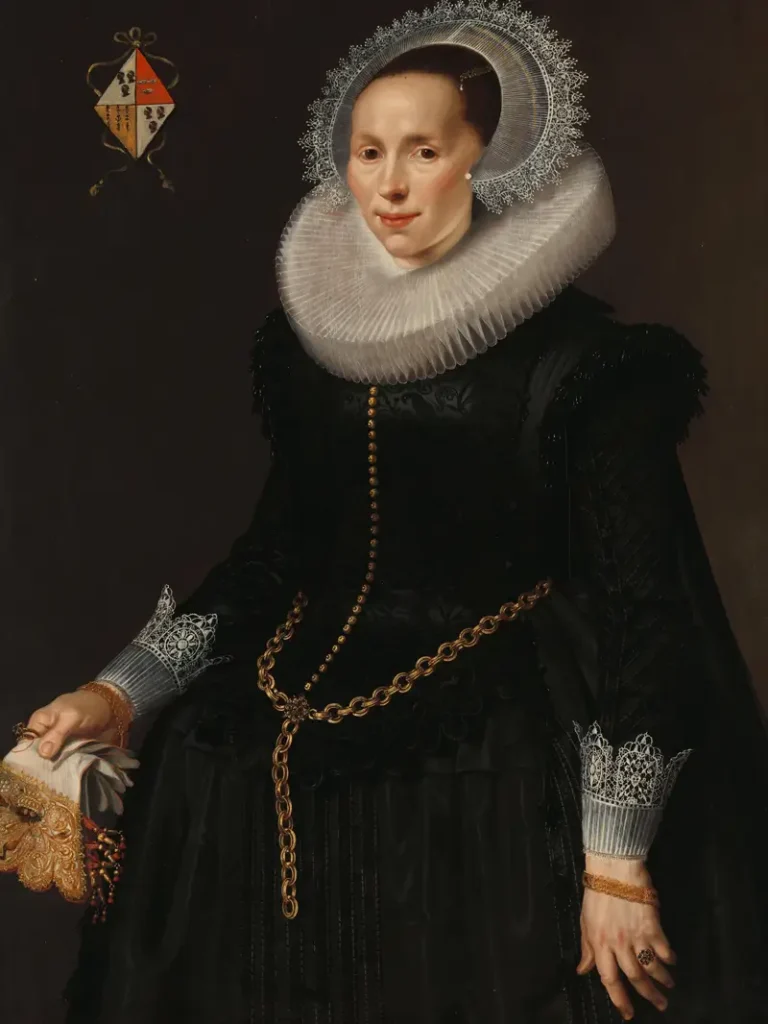
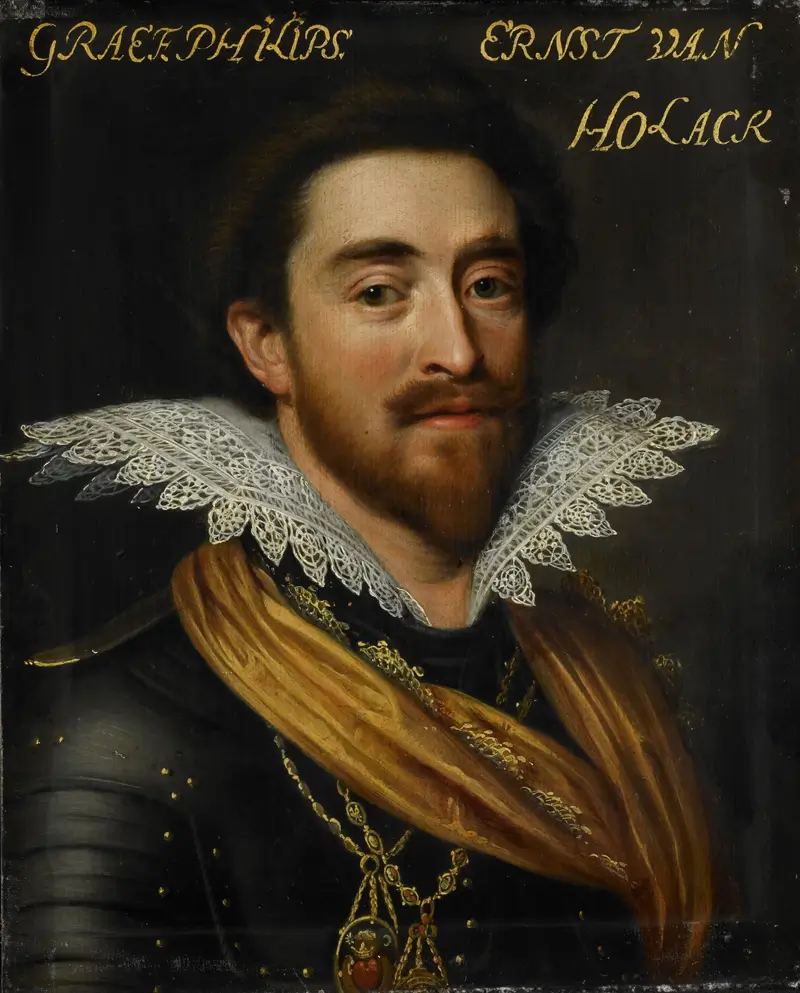
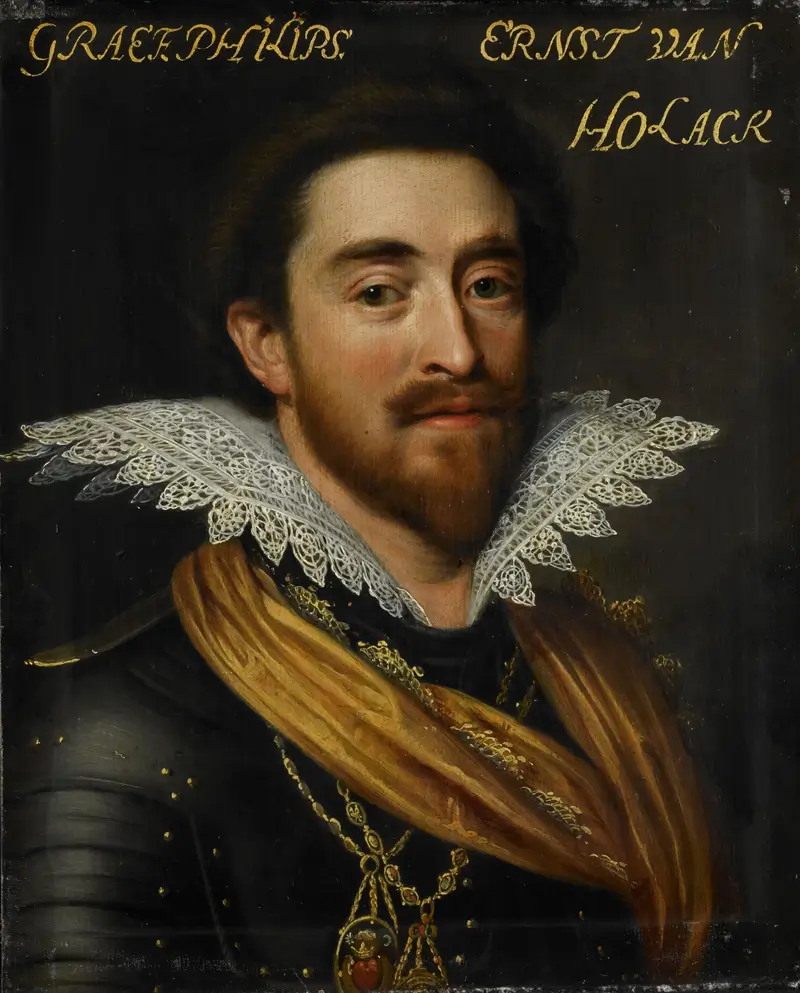
Between 1560 and 1620, the ruff became the defining feature of fashion. From 1560 onwards, the simple frill at the hem of the shirt evolved into a starched, tube-shaped, pleated linen structure that encircled the neck. The ruff was no longer part of the undershirt, but functioned as a garment in its own right, reaching enormous proportions by the beginning of the 17th century and becoming known in the history of fashion as the ‘millstone ruff’. Depending on the region, this ruff was trimmed with lace or made entirely of it. In the Republic of Venice, however, the ruff remained largely uncommon; there, the large, fan-shaped stand-up collar rising from the shoulders dominated. Flemish women preferred a closed ruff with three or four layers of fine bobbin lace, whilst English and French men opted for a large, square collar made of needle lace, which rose steeply towards the nape of the neck. Regardless of these regional preferences, however, the overarching pattern design of the lace used shows a striking stylistic kinship across Europe [5].
Symmetry in space: the geometric structure of early braided and needle lace
Early bobbin lace is primarily a form of geometric braided lace, stylistically closely related to Reticella needle lace. A defining feature here are bobbin-laced braids, which can also form linen-weave surfaces and follow a strictly geometric structure. The running threads are worked from linen, coloured or black silk, and fine gold and silver wires. Scallops, rosettes, stars and arches on horizontal and vertical groundlines dominate the design. As a result, depending on the design, this braided lace can appear both compact and weightless. The motifs of this braided lace are reflected in 16th-century Italian needle lace – particularly in Reticella needle lace itself, which is regarded as the precursor to all needle lace, as well as in the more freely designed Punto in aria.
Prohibitions, penalties and dress codes
The authorities in almost all European countries viewed with great disapproval the fact that considerable sums of money were being spent on luxurious linen, silk and metal lace. Consequently, vigorous attempts were made to regulate the wearing of lace by law. Meticulously drawn-up dress codes are enacted: they often reserve the privilege exclusively for royal families, stipulate the permitted width down to the millimetre, or prohibit the lower classes from wearing lace altogether. Regional variations clearly illustrate this strictness:
• Venice: The Jewish population is completely prohibited from wearing white bobbin lace, gold lace or silver lace. White bobbin lace made of linen was permitted to be no more than four centimetres wide; for women’s face veils, only black bobbin lace was allowed.
• Spain: In 1623, the Crown generally banned the wearing of lace to conserve foreign currency.
• France: The manufacture of metal lace is banned, as the precious metal is needed for coinage. The result is a thriving black market where cheap glitter is circulated as fine gold. As a deterrent, confiscated goods are publicly burnt in the market squares.
Behind these laws governing luxury lie not only economic interests but also deep-seated moral convictions. The Catholic Church denounces the arrogance of fashion as a mortal sin, whilst Protestantism imposes absolute discipline and austerity on the faithful. Furthermore, there is a fear that ostentatious displays of wealth might stir up social envy and jeopardise social harmony. Furthermore, the ruling classes are faced with an existential sociological question: how is one to distinguish an aristocrat from a wealthy merchant, or a merchant from a prosperous farmer, if they all wear the same fine lace? By the end of the 16th century, lace had long since become more than just an ornament or a precious fabric – it served as the status symbol par excellence [6].
Concluding Remarks
The 16th century thus transformed lace from a functional embellishment of undergarments into a barometer of social power relations. The rise of this luxurious textile object unfolded against a backdrop of striking dualism: whilst the radiant whiteness of the linen still embodied a profound spiritual purity in the collective consciousness, the subsequent display of splendour supplanted this symbolism in favour of a radically secular self-expression. Embedded within the geometric rigour of Spanish court fashion, the ruff and the ‘millstone collar’ became the visual centrepiece of elite identity. The draconian dress codes of the period prove that this development was far more than a mere fashion interlude. The attempts by European governments to regulate the consumption of lace through bans and public burnings highlight the immense economic and moral explosiveness of the fabric. In the 16th century, early bobbin and needle lace not only broke with textile conventions ; it established itself as an enduring, three-dimensional monument to the human desire for recognition.
(This translation was produced using DeepL. If any errors have crept in or if any technical terms have been translated inaccurately, I would be very grateful for your feedback.)
------------------------------------------------------------------
Bibliography
[1] Fehlig 1986, p. 88.
[2] Landini 2018, pp. 32 ff.
[3] Ibid.
[4] Ibid., pp. 32–34.
[5] Ibid., pp. 32–35; Kraatz 1989, p. 18.
[6] Kraatz 1989, pp. 18–22; Thiel 2010, p. 196.
------------------------------------------------------------------