
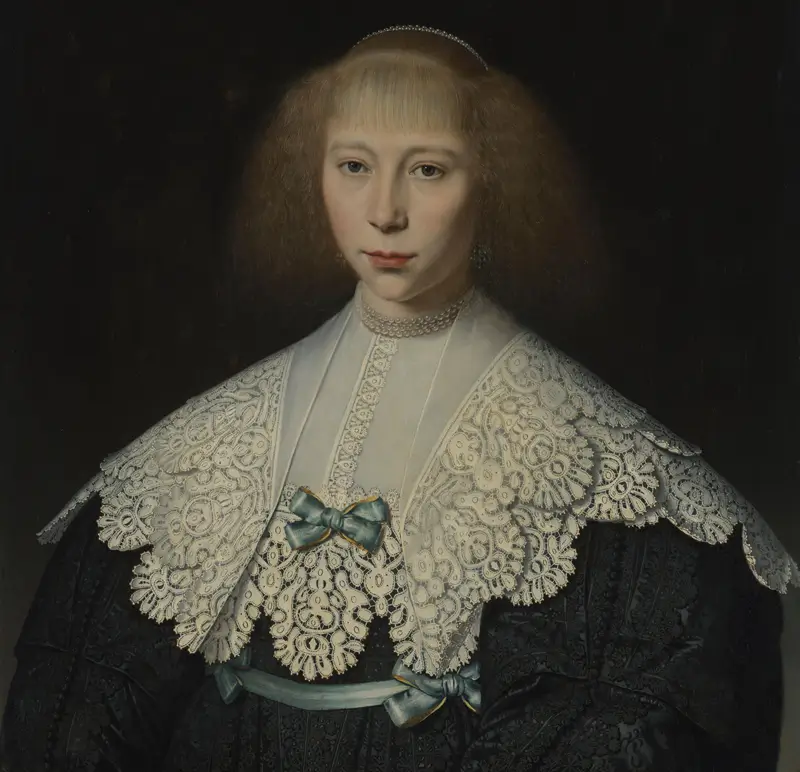
Lace in the context of European fashion history – the 17th century
For five centuries, lace has been far more than just a decorative detail. It is a textile status symbol that reflects social hierarchies, political influence and the evolution of European fashion from the 16th to the 21st century. The series ‘Lace in Context’ tells the story of bobbin and needle lace.
The 17th century: When lace became a political issue
From the 14th century until the end of the 15th century, the cities of northern Italy, particularly Venice, dominated the European trade in luxury goods. They were connected to almost the whole of Europe via sea, river and land routes. From the mid-16th century onwards, however, the Netherlands – which traded primarily in mass-market commodities such as grain, fish, timber and salt – began to take centre stage.
With the founding of the Dutch East India Company in 1602, the Dutch laid the foundations for supplanting Venice as the leading trading power [1]. The bustling activity in the port cities of Amsterdam and Antwerp, which were among the most flourishing centres in Europe during the 17th century, had a significant economic impact on the entire region.
The production of consumer goods was given a major boost – and with it, the expansion of lace-making. Flanders, at that time a Dutch county, not only possessed the necessary raw materials in abundance but also had excellent expertise in bleaching and spinning linen. Lace production flourished in Mechelen, Binche, Bruges and Brussels. There, specific styles and techniques developed that would remain forever associated with the names of these cities [2].
Changes in fashion during the Thirty Years’ War
From the perspective of fashion history, the influence of strict Spanish etiquette on European clothing began to wane noticeably with the outbreak of the Thirty Years’ War in 1618. The military increasingly came to dominate everyday life and, consequently, fashion, although there was no standardised uniform for soldiers. Erika Thiel points out that ‘the sash […] is the only “uniform” and rank insignia’ [2].
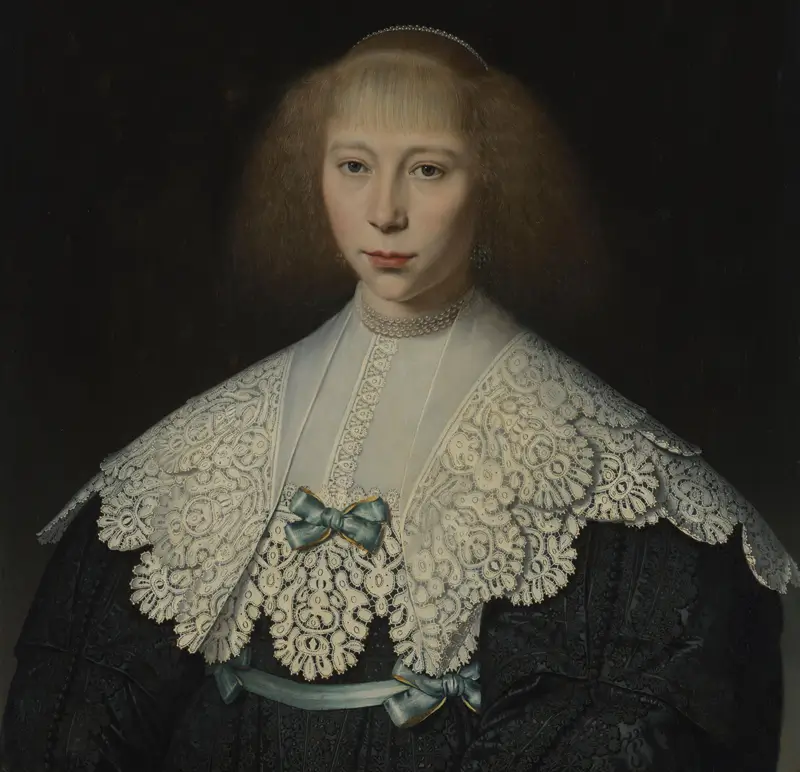
The era of the monumental, heavily pleated ruff came to an end, giving way to a simpler collar style. Large, flat collars that draped over the shoulders became popular and were worn by both women and men alike. Heavy and very dense lace now supplants the strictly geometric patterns and the pointed, jagged trims of early bobbin lace. The extraordinarily versatile Flemish linen bobbin lace, worked either with continuous threads or with increasing and decreasing threads, establishes the worldwide fame of the Flemish lace industry.
Floral splendour and fashionable asymmetry
Inspired by botanical imports from overseas, naturalistic elements are now increasingly finding their way into design. Magnificent Baroque tendrils, floral motifs and depictions of animals and people, artfully linked with bars, eyelets and picots, characterise the textile design. As the patterns are often highly complex and very large in scale, this lace is worked in separate sections.
As well as being used for collars, it finds application in a wide range of fashion areas:
• As wide cuffs on ladies’ and gentlemen’s sleeves
• On handkerchiefs, fans and gloves
• On shoes and the cuffs of men’s boots
• On luxurious church textiles
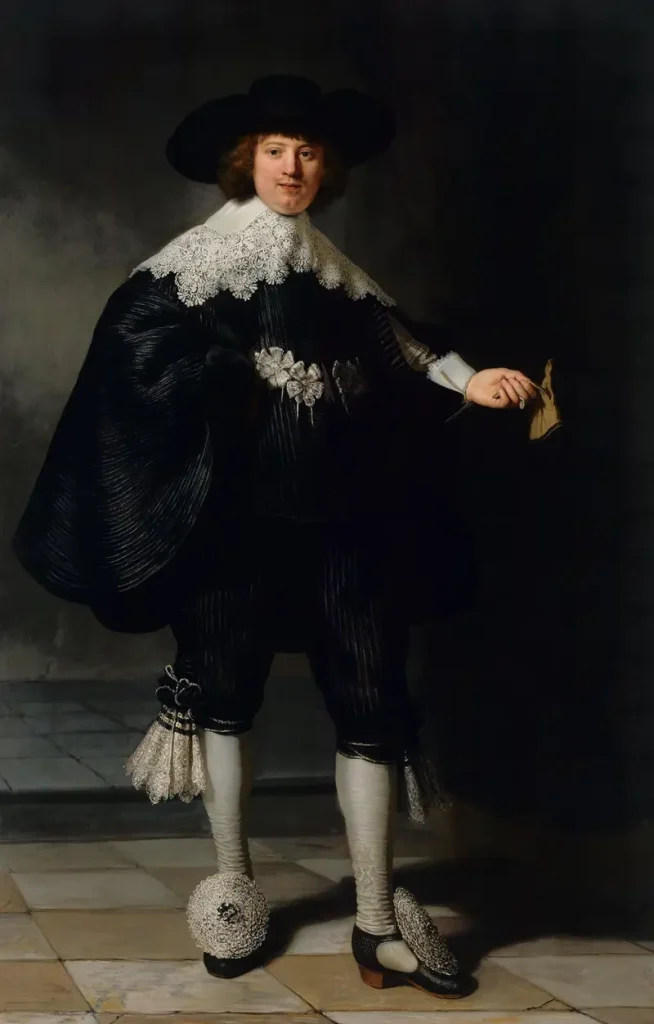
Hardly any other type of bobbin lace achieved such fame. Compared with men, however, women wore significantly less lace, particularly between 1630 and 1650; often their only lace trim consisted of a wide collar or a lace-trimmed shoulder cape [4].
A lack of innovation and the rise of smuggling
In the first half of the 17th century, France did not yet have a significant lace industry of its own. Although needle-made and bobbin lace were produced in centres such as Calais, Lille, Alençon and Le Puy-en-Velay, the high-quality lace demanded by the highly fashion-conscious upper classes could not yet be produced domestically.
Despite strict bans on luxury goods and high import duties, French capital therefore continued to flow out to Flanders and Italy, whilst smuggling flourished. In the process, traders devised highly creative methods:
• Dog smuggling: Lace was wrapped around the bodies of emaciated dogs and concealed beneath a second, larger dog’s pelt.
• Fake funerals: The precious goods were secretly transported across the borders in coffins.
Italy, for its part, was initially unable to compete with the dynamism of Flemish bobbin lace, as it lacked design innovation. Although Italian bobbin lace products were widely available, they lacked the artistic and economic vigour of their Flemish rivals, which is why Flemish goods were also imported into Italy in considerable quantities [5].
France’s rise and the mercantilist economic war
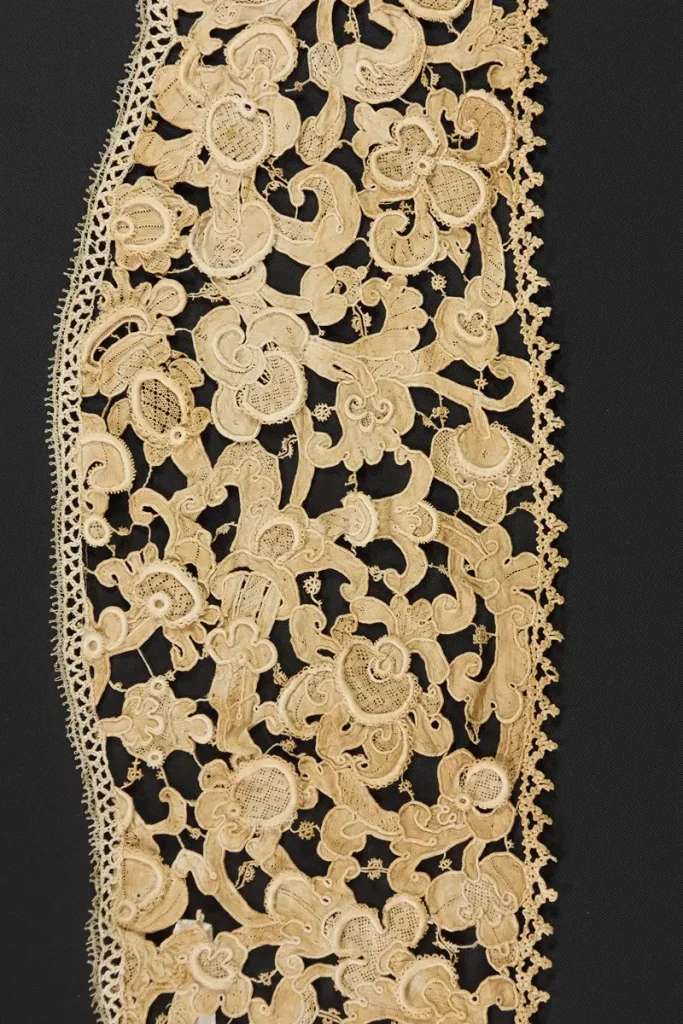
Around 1650, a completely new type of lace appeared on the market: the Gros Point de Venise – a needle lace with a pronounced, three-dimensional relief. With this, the Venetian lace-makers made an impressive comeback on the European market. Lace fashion was no longer characterised by abstract forms or stylised animals, but by large, flower-adorned tendrils in the form of a continuous, dynamic curve.
Through the artful layering of textile strands across different planes, this specific type of lace created three-dimensional chiaroscuro effects. These captivating light-and-shadow contrasts lent the material an extraordinary, relief-like depth and made it the ultimate status symbol of the European upper classes.
The Evolution of Men’s Fashion
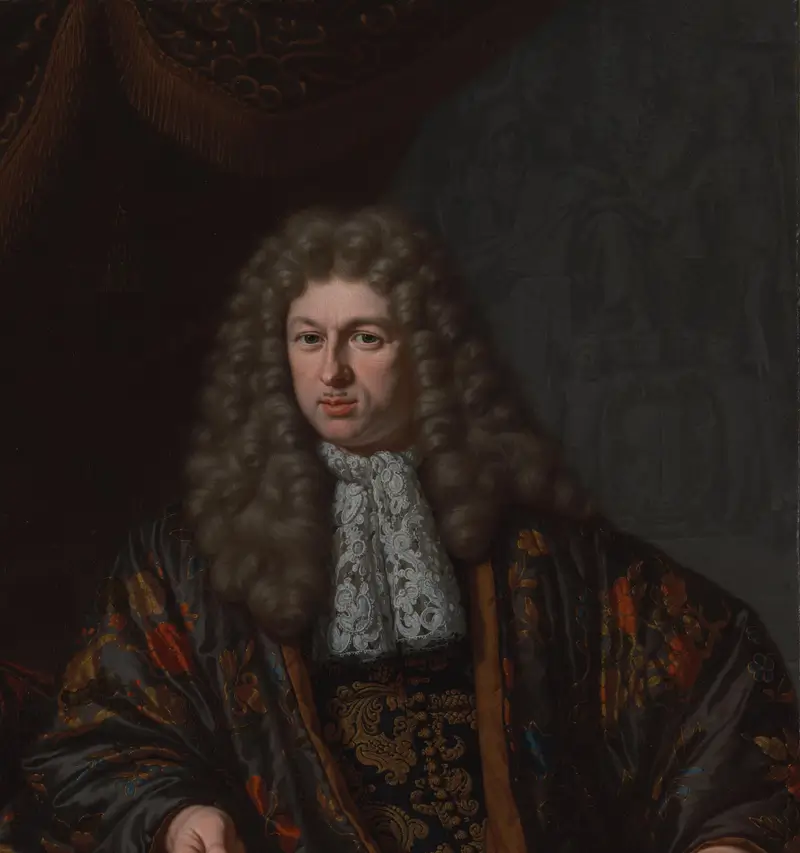
In the second half of the 17th century, under the absolutist rule of Louis XIV, France assumed political and cultural leadership in Europe – and from then on also dominated the world of fashion. This era brought about profound changes to the male silhouette. The voluminous allonge wigs of this era increasingly covered the shoulders, meaning that the large lace collars previously worn by gentlemen lost their decorative effect.
As a result, the collar initially shrank at the sides and at the nape of the neck, until only a pleated strip remained at the front. As its ends became progressively longer, this evolved into the classic neckerchief and eventually the tie. In the centre of the chest – for example, as an ornate jabot – and at the cuffs, where lace in the form of exquisite cuffs emphasised the wearer’s status, the use of heavy Gros Point de Venise remained indispensable, however.
The evolution of women’s fashion
For women, on the other hand, the focus shifted to other areas. Lace now adorned low-cut necklines and framed the half-length sleeves in the form of ruffles. It also adorned the opulent headdresses: the voluminous ladies’ hairstyles of the time – known as the ‘fontange’ – were topped with bonnets featuring long, hanging lace ribbons, known as ‘barben’. These provided an ideal backdrop for the latest textile creations. In this sumptuous women’s fashion, heavy, three-dimensional lace was predominantly used to frame the bare shoulders monumentally in the form of an all-round yoke, or to decorate elaborate hairstyles. [6]. The voluminous ladies’ hairstyles, known as the ‘fontange’, were adorned with bonnets featuring hanging ribbons – the ‘barbes’ – which provided an ideal showcase for the latest lace creations [7].
The Gold of Absolutism
Luxury textiles held outstanding strategic importance for the French economy. Jean-Baptiste Colbert, Minister of Finance and Trade, aptly formulated the mercantilist principle:
‘If Spain’s power lay in the gold of Mexico, we have our gold within our own country, in French fashions and precious velvets, silks and lace.’ [8].
This led to fierce trade disputes between Venice and France, characterised by industrial espionage, secret agents, coded letters and the targeted poaching of skilled workers. From the 1630s onwards, laws were enacted almost annually that either banned or restricted the use of lace (I will discuss the so-called sumptuary laws (loi somptuaire) in a separate blog post). Yet the immense demand from the elite forced France to continue importing the luxury good ‘lace’ in vast quantities from Venice [9].
Because importing the finest lace from Venice was costing a considerable sum, Colbert realised that the solution did not lie in repressive dress codes. Instead, he focused on the targeted promotion of domestic production centres.
However, due to the scattered and poorly structured craft centres in France at that time, there was a lack of a uniform style. Colbert therefore initiated the establishment of royal lace manufactories in Reims, Arras, Alençon, Aurillac and Sedan, amongst other places. These enterprises received state subsidies, were exempt from duties and taxes, and held a ten-year monopoly on lace production. According to Anne Kraatz, all products manufactured there had to be marketed under the protected designation ‘Poinct de France’ [10].
The battle for expertise
In order to match the quality of its competitors from Venice and Flanders, France deliberately poached top female craftswomen: around 30 skilled workers from Venice and some 200 from Flanders moved to French workshops, lured by the immediate grant of French citizenship. Venice attempted to counter this exodus and issued a decree threatening the executed workers with execution for treason if they refused to return.
Nevertheless, the French workshops initially lacked technical know-how – a shortcoming that even intensive industrial espionage could scarcely conceal. Between 1660 and 1670, French and Venetian needle lace were visually almost indistinguishable from one another, whilst the bobbin lace produced in France closely resembled its Flemish models [11].
France’s path to its own style
Colbert, however, had no intention whatsoever of merely copying foreign styles; his aim was to create a distinctive French style. A design workshop was therefore opened in Paris, where court artists and painters produced exclusive designs for French lace. As these designs were permitted to be produced and sold exclusively in the royal manufactories, the income of freelance lace-makers fell, which in turn encouraged the black market.
The Triumph of Point de France and the Comeback of Bobbin Lace
Within ten years, a completely new type of needle lace was finally developed: the Point de France. The large reliefs of the Venetian models were now dispensed with. Instead, the design was dominated by a mesh of large, hexagonal stitches, finished with tight buttonhole stitches and edged on all sides with fine picots.
Fig .5: Rijksmuseum Amsterdam, Dasslip van naaldkant met candelabre-motieven, anoniem, ca. 1690 - ca. 1709
Point de France proved so immensely successful that it was very soon being copied and produced even in Venice itself. This new form of needle lace adorned collars, cravats, bonnets and aprons; it graced the dressing tables of the upper classes as lace frills; and it was used to embellish liturgical vestments.
In terms of price, this textile art was highly exclusive: Louis XIV, for example, purchased Point de France lace in July 1666 for the astronomical sum of 18,491 livres.
A historical price comparison illustrates just how luxurious this was:
• 18,491 livres: the King’s lace budget in July 1666
• 11,200 livres: the entire annual salary of the principal court painter, Charles Le Brun
• 8,000 livres: a piece of ornate furniture by the famous cabinetmaker André-Charles Boulle
Economic downturns and the Flemish heritage
At the end of the 17th century – after the needle-made lace styles Gros Point de Venise and Point de France had dominated the market for almost 50 years – bobbin lace regained ground. With the revocation of the Edict of Nantes [12] by the French king in 1685, French production declined drastically, as the flight of the Huguenots meant that numerous Protestant lace-makers and their expertise also left the country. To make matters worse, the market for heavy needle lace gradually collapsed, and in 1698 England imposed a strict import ban on French lace [13]. The Netherlands, on the other hand, was not affected, as it successfully threatened the English with an import ban on English wool in retaliation. Flanders benefited considerably from this trade policy exemption and consolidated its dominant position in the European lace industry [14].
Concluding Remarks
The 17th century saw lace finally transform from an elite decorative element into a highly contested instrument of geopolitics. With the decline of Spanish court etiquette and the upheavals of the Thirty Years’ War, the rigid, geometric constraints of the Renaissance gave way to the dynamic, floral splendour of the Baroque. In the wake of this, the economic epicentre of the continent shifted: whilst the Netherlands and Flanders flourished through the industrialisation of the linen trade and smuggling defied borders using bizarre methods, Venice responded with the sculptural grandeur of Gros Point de Venise. The ultimate turning point was ultimately brought about by French absolutism under Louis XIV and his minister Colbert. By nationalising the textile industry through rigorous mercantilism, they elevated lace to the status of ‘the gold of France’ and established it as the status symbol par excellence and a strategic state resource of the Grand Siècle.
(This translation was produced using DeepL. If any errors have crept in or if any technical terms have been translated inaccurately, I would be very grateful for your feedback.)
------------------------------------------------------------------
Bibliography and Notes
[1] Pach 1969, pp. 179–189.
[2] Kraatz 1989, pp. 36–52.
[3] Thiel 2010, pp. 211–212.
[4] Mayerhofer-Llanes 2014, p. 14; Schuette 1981, pp. 59ff.; Schöner 2003, pp. 68–73; Kraatz 1989, p. 42.
[5] Schuette 1981, pp. 131–134.
[6] Kraatz 1989, pp. 42–45; Landini 2018, pp. 38 ff.
[7] Mayerhofer-Llanes 2014, p. 16.
[8] Bombek 2005, p. 235.
[9] Thiel 2010, p. 225.
[10] Kraatz 1989, pp. 36–52.
[11] Ibid.; Schuette 1981, p. 134.
[12] The Edict of Nantes of 13 April 1598 granted Calvinist Protestants religious tolerance and full civil rights in Catholic France. Catholicism remained the state religion. On 18 October 1685, Louis XIV revoked it.
[13] Kraatz 1989, pp. 36–52.
[[14] Dreger 1901, p. 52.
-------------------------------------------------------------------