
Lace in the context of European fashion history – the 18th century
For five centuries, lace has been far more than just a decorative detail. It is a textile status symbol that reflects social hierarchies, political influence and the evolution of European fashion from the 16th to the 21st century. The series ‘Lace in Context’ tells the story of bobbin and needle lace.
The 18th century: An era of specialisation and ethereal luxury
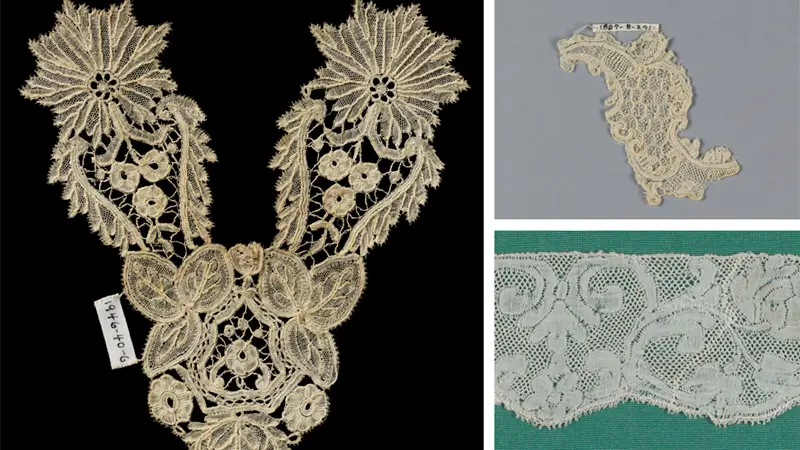
In the history of textiles, the 18th century represents an era of marked specialisation. Traditional Flemish bobbin lace gave rise to regionally distinct variants such as Brussels, Binche, Valenciennes, Mechelen and Lille lace. At the same time, in the field of needle lace, the exquisite handcrafted products from Alençon, Argentan and Sedan emerged. All these textile innovations reflected the contemporary fashion trend towards lightness, smoothness and suppleness [1].
Structural change and market conditions in France
In France, at the start of this period, the market for high-priced domestic needle lace collapsed. As state subsidies for the royal lace manufactories were withdrawn, production centres such as Argentan, Le Puy, Caen, Le Havre and Rouen were forced to become economically self-sufficient. Aesthetically, the quality of these products initially declined during this transitional phase. Nevertheless, consumer demand in the first half of the 18th century was so strong that jobs in these regions were preserved thanks to the constant demand [2].
This sustained economic boom, coupled with the accompanying protectionist import bans and astronomical luxury taxes – whose roots lie in the mercantilist economic policies of the late 17th century – gave rise to a highly organised, transnational smuggling network. As domestic manufacturers were often unable to meet the immense demand, either in terms of quality or quantity, well-established illegal import routes from the Habsburg Netherlands flourished. Contemporary customs and court records document creative and, at times, bizarre methods of transport, such as the systematic use of trained smuggling dogs or the concealment of precious textiles in coffins and hollowed-out foodstuffs. This illegal trade developed into a highly profitable speculative venture, with the European aristocracy and diplomats in particular acting as the primary buyers of these continental luxury goods [3].
The social diffusion of the luxury goods trend
Between 1720 and 1760, European nations experienced significant population growth and a rising standard of living. The restrictive luxury laws of the previous century, which prohibited certain social classes from wearing lace on pain of punishment, ceased to apply. Demand for lace intensified across all social classes. Even lower-quality lace sold like hot cakes: maids imitated their mistresses’ style of dress, and the rural population caught up with the urban – albeit using more affordable materials [4].
The Flemish production miracle
Flemish bobbin lace in particular benefited from this market boom. It was lighter and more delicate than Venetian relief lace, which had largely become anachronistic, and could also be produced more efficiently than French ‘Point de France’ needle lace. Flanders offers ideal structural conditions for this: lace-making has been firmly established there for generations as a proto-industrial cottage industry – there is documentary evidence that children in this region had been making bobbin lace for a living as early as 1585.
Furthermore, production is underpinned by a highly developed, time-honoured linen-making tradition. The spinners carry out painstaking, precision work: in 17th- and 18th-century Flemish lace, hand-spun threads are worked with such finesse that up to 222 threads lie side by side across a width of just one centimetre. The royal capital of Brussels, with its established merchant class and extensive trade networks, consequently rose to become a global distribution centre [5].
Technological innovations in Brussels’ lace-making
Brussels’ lace-making workshops initially experimented with various techniques. Alongside traditional bobbin and needle lace, ‘Point de Bruxelles’ began to emerge from the mid-17th century onwards. Friedrich Schöner [6] explains that the technological advance lay in a new, modular method of working: individual floral motifs are bobbin-laced separately and only subsequently joined together through further bobbin work or using needle techniques. A modified, round and rotatable bobbin pillow also makes it possible to guide the threads in a spiral pattern around the centre point. This process allows lace to be produced in any width. The economic advantage of this method is substantial: by joining self-contained segments, not only is lace production accelerated, but producers can also respond much more flexibly to volatile fashion trends.
The dominance of lace in fashionable silhouettes
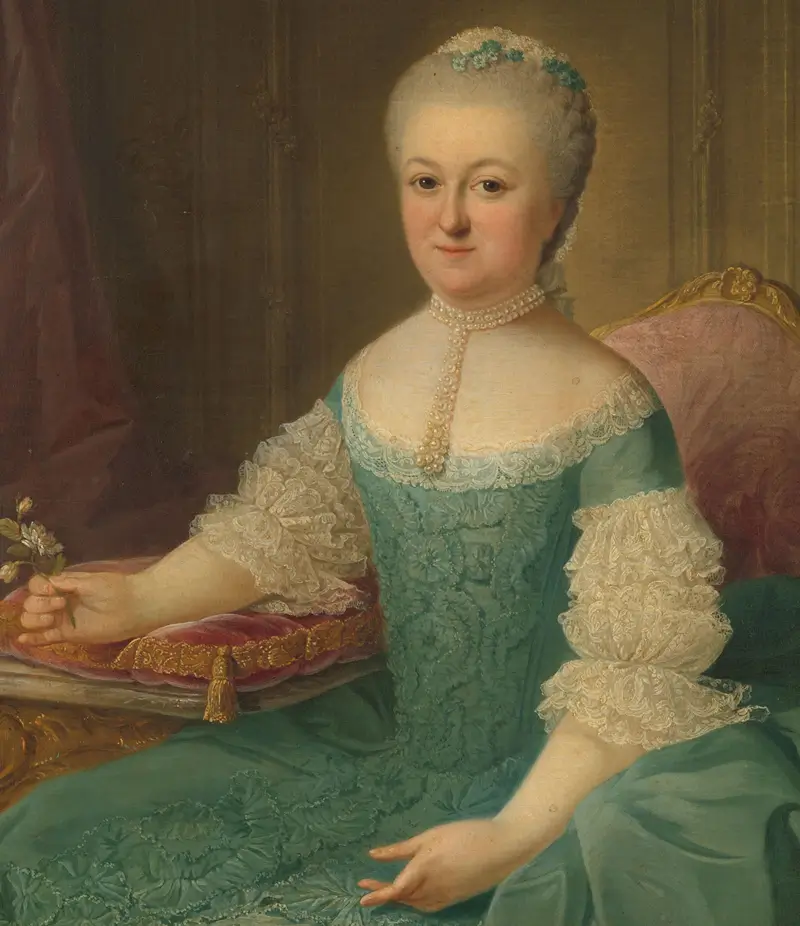
As the century progressed, lace became the dominant decorative element. It was applied to garments in gathered or pleated forms, where it contrasted visually with the vibrant colours of the silk fabrics. The key driving force behind this surge in consumption was a newly emerging, economically influential group within the textile industry: the Marchandes de Modes (fashion designers). Led by figures such as Rose Bertin, the legendary ‘Ministre des Modes’ to Queen Marie-Antoinette, these businesswomen established an early form of haute couture. From an economic perspective, they operated less as traditional dressmakers and more as stylists and distributors: they purchased plain, basic dresses at the market, only to enhance their aesthetic appeal afterwards by adding lace flounces, bows and appliqués. Through the export of fashion dolls, known as ‘Pandoras’, Bertin succeeded in introducing Parisian fashion trends to the European royal capitals. The result was a rapid increase in lace consumption [7].
For the first time in the history of costume, it can be observed that women wear more lace trimmings than men, although men’s wardrobes by no means do without it entirely. It now incorporates this delicate material in a striking and prestigious manner: in particular, the jabot – an opulent, lace-trimmed bib – and the cravat protrude decoratively from the waistcoat of the three-piece suit (Habit à la française).
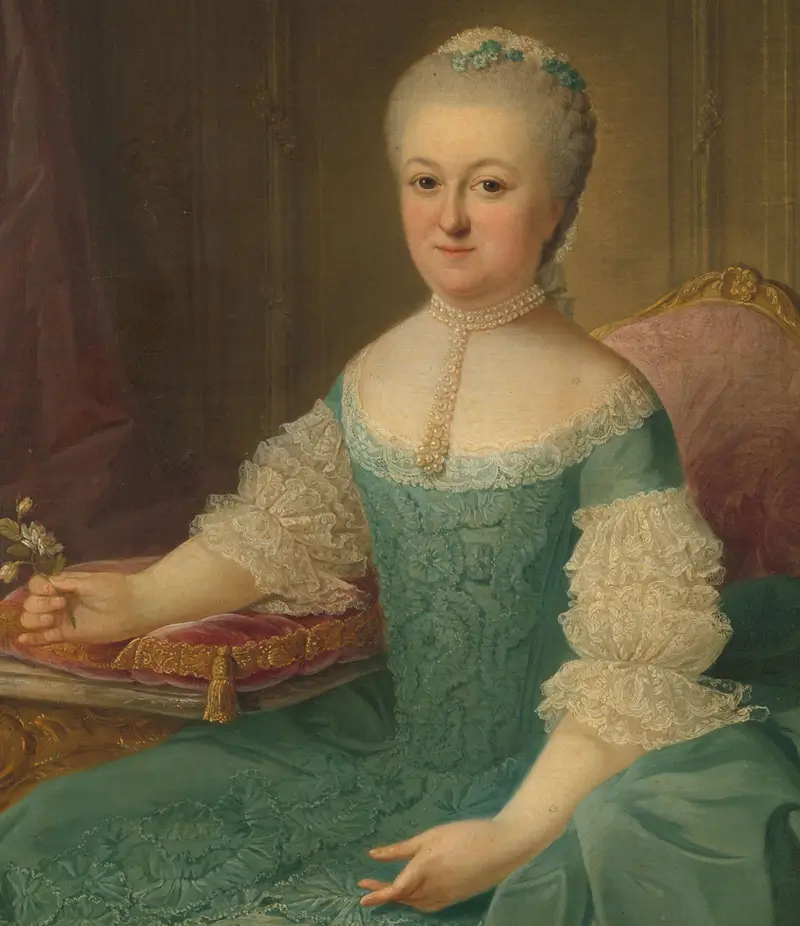
In contrast, lace dominates women’s attire to an unprecedented extent. Bonnets and bonnet ribbons are made entirely of lace. On the lower sleeves of the dresses, the so-called ‘engageantes’ – cascading, multi-layered sleeve flounces – are worn in three to four layers one on top of the other. Whilst the fichu – a triangular, gossamer-thin neck scarf that picturesquely frames the décolleté – is adorned with gold and silver lace, the bodice is embellished with gold and silver lace. These are applied directly to the ‘Stecker’ (Pièce d’estomac), that highly decorated, stiff front panel which shapes the female upper body. Even the sweeping skirt panels of the robe à la française and their hems are trimmed with metre-long flounces. This textile display is only visually maximised by the panier hoop skirt, which dramatically expands the width of the skirt panels and thus provides the display area for the precious lace trimmings in the first place [8].
Economic Disparities and Representational Value
Behind the aesthetic elegance lies an immense socio-economic disparity. A single ell of lace (approx. 1.20 m) cost a considerable sum around 1765:
• Superfine needle lace: 480 livres
• Bruges lace: 230 livres
• Genuine Valenciennes: 190 livres
• Mechelen lace: 95 livres
For a suitable pair of cuffs, which requires around four metres of fabric, the cost when using Valenciennes lace amounts to around 760 livres. To put this sum into historical context: it is equivalent to 32 heavy Louis d’or gold coins, the price of ten stagecoach journeys across the French kingdom, or the purchase price of a complete, valuable original edition of the famous Encyclopédie by Diderot and d’Alembert.
By way of comparison: the average annual wage of a lace-maker in Valenciennes at the same time was merely 156 livres. The finished product thus represents the equivalent of several years’ labour on the part of the maker. The precious lace consequently serves as the quintessential symbol of class, functioning as an instrument of aristocratic self-presentation and social self-affirmation for the elite [9].
A turning point and paradigm shift at the end of the century
The profound social, political and intellectual upheavals of the French Revolution at the end of the 18th century marked the end of the Ancien Régime. The structural political change brought about a radical shift in fashion aesthetics. A new aesthetic of simplicity gained ground, leading to a noticeable decline in demand in the lace industry from around 1770 onwards.
In addition to the political turning points, this decline was also largely attributable to a technological paradigm shift that originated in England. As early as the 1760s and 1770s, inventors such as Robert Frost succeeded in making decisive modifications to the classic stocking frame. With the development of the so-called ‘Point Net’, it became possible for the first time to imitate tulle-like mesh fabrics by machine and on a mass scale. This emerging proto-industrial machine-made lace industry, which rapidly established itself in the Nottingham area, flooded the European market with low-cost imitations. It placed traditional, time-consuming handcrafted goods under massive economic pressure to compete and foreshadowed the eventual marginalisation of handcraft in the following century [10].
Where lace trimmings are still tolerated on garments, these are limited to what is known as ‘Blonde lace’ (made from cream-coloured silk with continuous threads), which can be produced much more quickly and cost-effectively. Production remains in France, Venice and Spain, mostly in orphanages, where children as young as five are trained in this standardised technique. By the end of the 18th century, hand-made lace had outlived its usefulness as a status symbol and object of prestige – it lost its standalone splendour and henceforth served primarily as an unobtrusive backdrop for other decorative elements [11].
Concluding Remarks
The 18th century established lace as the epitome of an ethereal, highly specialised luxury. As part of the stylistic shift towards lightness and suppleness, the dominance of Baroque relief lace began to wane, giving way to a wealth of regionally diverse bobbin and needle laces. Whilst restrictive luxury laws lost their hold, ushering in an unstoppable social diffusion of the trend, proto-industrial Flanders, with its long-standing linen tradition, emerged as the global epicentre of production. Technological innovations such as modular, segmented manufacturing in Brussels revolutionised production processes and enabled flexible adaptation to the volatile fashion market. Driven by the Marchandes de Modes led by Rose Bertin, this luxury textile finally broke free from the constraints of mere decoration. On the sweeping panier hoop skirts of the robe à la française, lace – whether as a bonnet, fichu or cascading engageantes – unleashed a veritable feast of material opulence. Behind the playful elegance of the Rococo, however, lay – right up until the eve of the Revolution – an immense socio-economic disparity that powerfully underlines the astronomical status value of this textile status symbol.
(This translation was produced using DeepL. If any errors have crept in or if any technical terms have been translated inaccurately, I would be very grateful for your feedback.)
-------------------------------------------------------------------
Bibliography
[1] Kraatz 1989, pp. 71–84.
[2] Ibid.
[3] Jackson 1900, pp. 78–81; cf. Farrell 2016, pp. 268–294.
[4] Kraatz 1989, pp. 71–84.
[5] Ibid.; Gächter-Weber 1997, p. 22; Schuette 1981, pp. 170–175.
[6] Schöner 2003, p. 84.
[7] Accessed online on 05 August 2026: Château de Versailles; female figures; Radio France.
[8] Kraatz 1989, pp. 71–84; Thiel 2010, pp. 248–259; Landini 2018, pp. 40, 41.
[9] Kraatz 1989, pp. 71–84.
[10] Felkin 1867, Landini 2018, p. 41.
[11] Kraatz 1989, pp. 71–84; Schöner 2003, pp. 68–73.
-------------------------------------------------------------------