
Lace in the context of European fashion history – the 19th century
For five centuries, lace has been far more than just a decorative detail. It is a textile status symbol that reflects social hierarchies, political influence and the evolution of European fashion from the 16th to the 21st century. The series ‘Lace in Context’ tells the story of bobbin and needle lace.
The 19th century: Napoleon’s revival of lace and the decline of the industry
Towards the end of the 18th century, lace-making in France declined dramatically in importance. The French Revolution declared this luxury textile a symbol of aristocratic frivolity. Consequently, production shifted towards simpler embellishments for undergarments, and patterns in France – as well as in Flanders, Italy and Spain – became reduced to small, constantly repeating motifs. Despite this ideological shift away from lace, the Welfare Committee granted state subsidies to the Alençon City Council as early as 1794 to revive lace production. This measure stemmed from purely practical considerations: the crisis-stricken state urgently needed export goods that would bring in foreign currency. Furthermore, the government sought to counteract the threat of mass unemployment. However, economic success remained limited, as the traditional markets were disappearing [1].
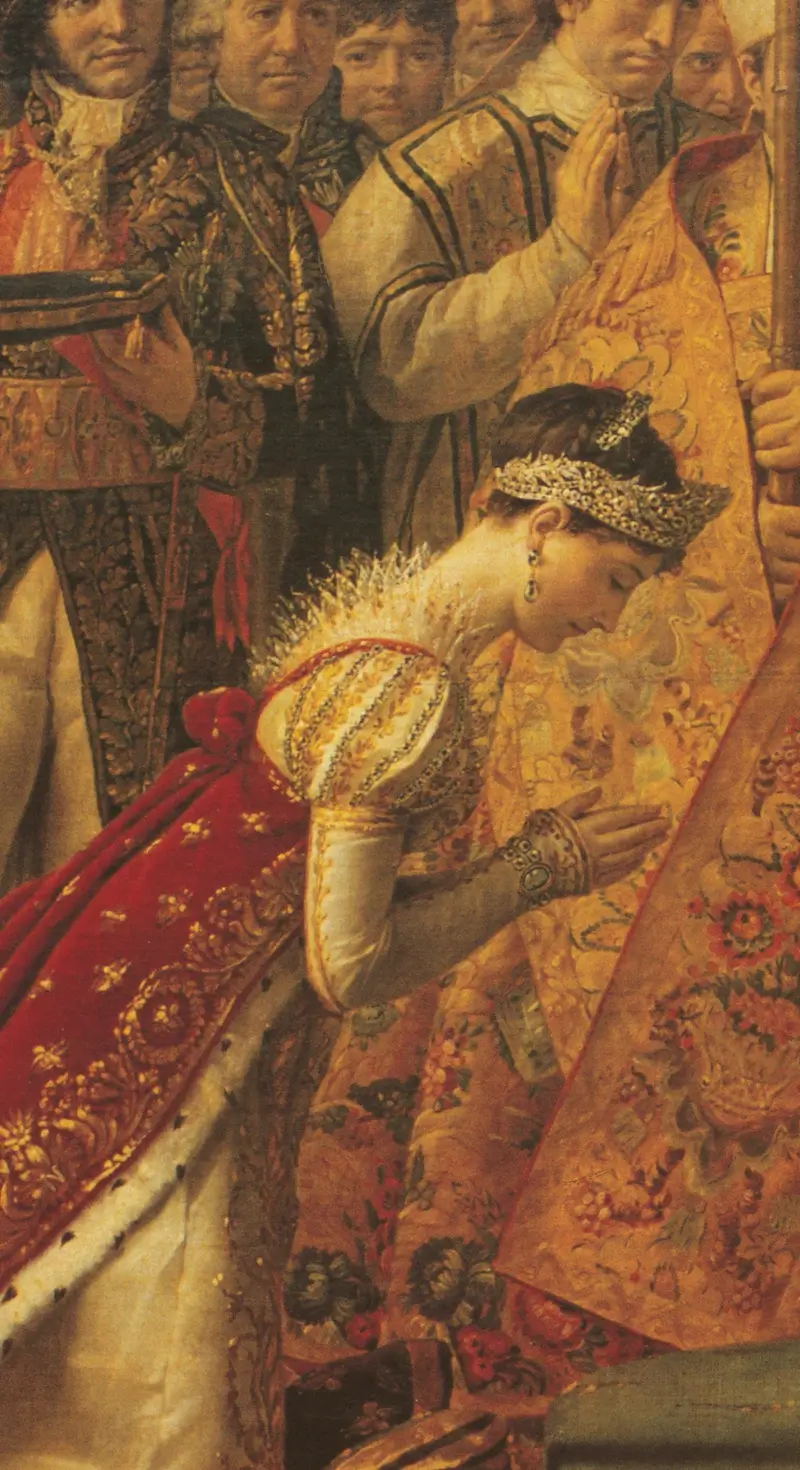
The coronation of Napoleon I in 1804 marked a fundamental turning point. For reasons of prestige, to legitimise his power and to stimulate the domestic economy, the Emperor pushed for the revitalisation of the luxury goods sector and, with it, the lace industry. At his coronation as Emperor in December 1804, Napoleon I wore a tie made of Alençon lace. Joséphine’s coronation gown was adorned with a stiff, fan-shaped ruffle made of the finest Alençon lace, known as the Chérusque collar.
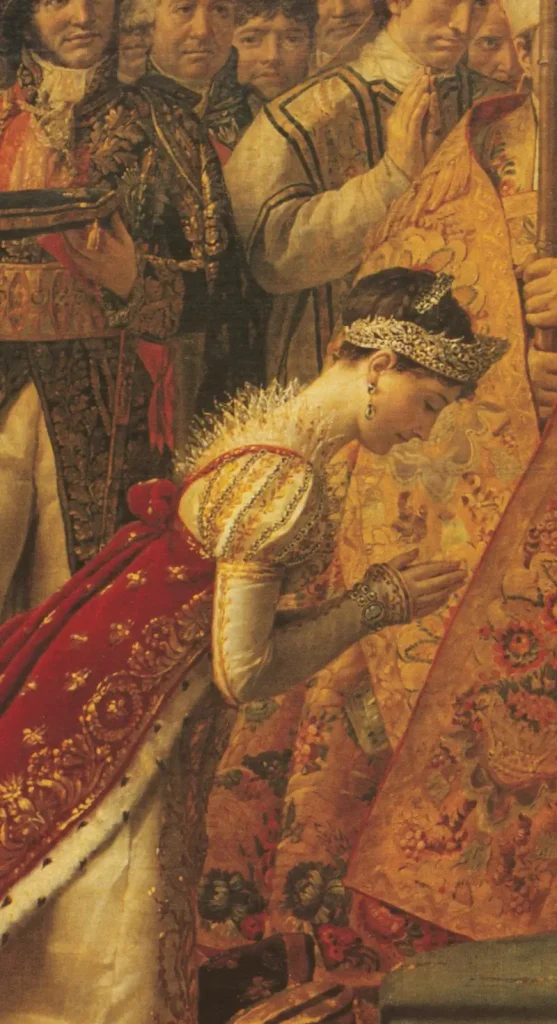
With regard to lace, the new imperial court protocol stipulates that both ladies and gentlemen must wear lace on official occasions. For men, the cravate de dentelle is mandatory [3]. Outside this courtly context, however, there are no longer any class-based dress codes. For the male wardrobe, this decree proved to be a final, artificial act of defiance: a changing understanding of bourgeois roles gradually banished lace from men’s fashion from then on – a phenomenon also known in fashion history as the ‘Great Masculine Renunciation’ [2]. The survival of the French manufactories – which now also included the annexed South Flanders, including Lille – depended largely on imperial and court commissions. The lace trousseau of the French Emperor’s second wife, the Austrian Marie Luise, for example, was valued at 70,000 francs [3]. At the same time, a male worker’s annual earnings amounted to approximately 550 francs, whilst a female worker’s were approximately 350 francs [4].
The invention of machine-made tulle: the bobbinet machine as a disruptive innovation
From 1803 onwards, nationwide industrial exhibitions signalled a temporary consolidation of the industry. However, this recovery was abruptly interrupted by a radical technological innovation: the advent of machine-made tulle. In 1808, the Englishman John Heathcoat designed the mechanical bobbinet machine. By studying the manual movement of the bobbins, he succeeded in mechanically replicating this process. The resulting smooth, unpatterned tulle proved to be of equal quality to the hand-made mesh fabric, yet could be produced many times faster and more cost-effectively.
This new form of competition posed such an existential threat to traditional manufacturers that, in 1812, the president of their trade association called for a government ban on machine-made tulle for everyday and court attire. However, the momentum of industrialisation could no longer be slowed; by 1833, there were already around 1,500 bobinet tulle machines in France [5]. Complete technological disruption took place from the 1830s onwards, when further mechanical developments (such as the Leavers machine) made it possible to weave even complex patterns fully automatically and to imitate handwork perfectly.
Fashion in the Biedermeier period: Regional traditional costumes and the new appliqué lace
Alongside urbanisation and courtly fashion, a counter-phenomenon in cultural history was taking shape in rural areas: the emergence of regional traditional costumes. In France and the Netherlands, the traditional headdresses worn by the peasant population developed into monumental, richly decorated structures. This development generated a massive demand for lace, although this often came at the expense of fine craftsmanship in favour of sheer volume (for example, to achieve dense pleating). From the 1830s onwards, this rural aesthetic in turn influenced middle-class fashion, helping bobbin lace to enjoy a renewed heyday. Needle lace, on the other hand, lost its market relevance, as it was stigmatised in the collective consciousness as an outdated attribute of the Ancien Régime.
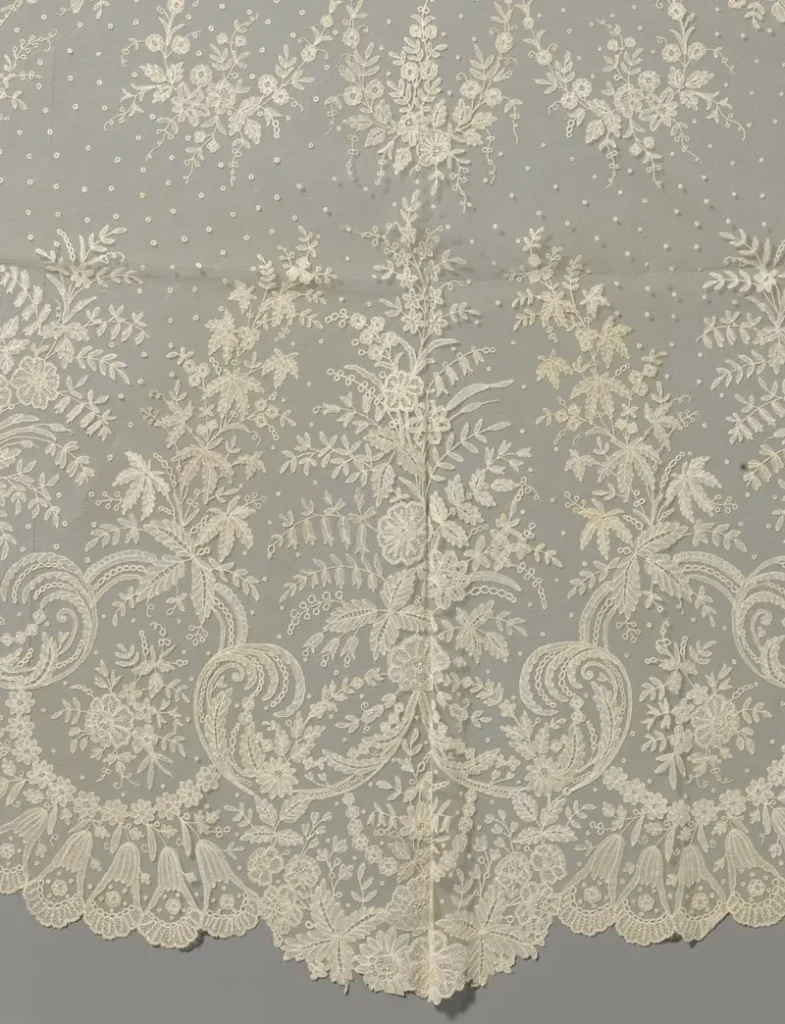
The manufacturers’ technological response to machine-made tulle lies in a symbiotic process: appliqué. This involves applying hand-made bobbin lace or needle lace motifs to a mechanically produced tulle base. This hybrid process drastically reduces production time and lowers retail prices. Paradoxically, hand-made lace production benefits from this rationalisation, as the remaining manual work is given greater aesthetic value. In the wake of Biedermeier fashion, with its voluminous puff sleeves and wide skirts, richly decorated waist flounces, white wedding dresses and veils (featuring Mechelen, Blonde and Brussels lace), as well as opulent lingerie (particularly featuring Valenciennes lace), became fashion imperatives [6]. Thanks to mechanised production methods and the emergence of department stores, lace became affordable for the general public as well [7].
The heyday of the European lace industry: world exhibitions and global exports
Around 1860, the global lace market reached its historic peak. This boom was catalysed by the world’s fairs and national industrial exhibitions that were popular in the 19th century. As transnational forums for innovation and historicism, they provided a rich source of inspiration through the presentation of new designs and historical exhibits. At the same time, the emergence of Parisian haute couture acted as a powerful aesthetic and economic catalyst. Fashion designers such as Charles Frederick Worth showcased exquisite types of lace – in particular the delicate Chantilly lace – on opulent evening gowns for prominent figures such as Empress Eugénie, transforming this luxury fabric into the ultimate status symbol of international high society.
In Mirecourt and Le Puy, lace production experienced a renewed boom. In the Vosges, imitations of Brussels and Bruges lace – in particular Duchesse lace, but also appliqué lace and guipure lace – were produced. However, the most important centre for bobbin lace in France was situated in the south of the Massif Central, in Le Puy-en-Velay. Around 1867, over 100,000 women and girls are said to have been working in lace production there. They mainly produced Torchon, Chantilly, Cluny and black solid-silk guipure lace.
In Belgium, mass production of Valenciennes, Gaze and Duchesse lace, as well as Brussels appliqué, predominates. North and South America are major markets for both French and Belgian lace production.
Italy also reactivated its production facilities, with the emerging educated middle-class tourism market serving as the primary outlet. However, due to structural organisational shortcomings and a rigid adherence to Renaissance models, Italian production remained commercially unviable and failed to keep pace with current fashion trends [8].
The Franco-Prussian War of 1870–71 and the ensuing socio-economic upheavals threatened lace production not only in France but also in neighbouring countries. Towards the end of the 19th century, a semantic and functional divide emerged: in common parlance, the term ‘lace’ became synonymous with the ubiquitous, cheap machine-made goods. As mechanical looms were now capable of perfectly imitating almost every manual technique, the textile lost its status as an exclusive luxury good [9].
Concluding Remarks
The 19th century marked a period of profound transformation, during which European lace evolved from an aristocratic privilege to an industrialised mass-produced commodity. This era was characterised by three key developments:
• Political upheavals and social change: Following the decline of lace culture brought about by the French Revolution, the Napoleonic Restoration led to a temporary revival of lace as a symbol of state status. At the same time, the ‘Great Renunciation of Men’ banished lace once and for all from men’s fashion, turning it into a luxury and fashion item with purely feminine connotations.
• Technological disruption: The invention of the mechanical bobbin lace machine in 1808 and its subsequent developments plunged traditional handcrafting into an existential crisis. Manufacturers responded with a spirit of innovation and a symbiotic blend of processes: by applying hand-made motifs to machine-made tulle bases, alongside machine-produced items, they created lace that was affordable and reached the mass market via newly emerging department stores.
• Economic zenith and globalisation: Fuelled by the emergence of Parisian haute couture and the platform provided by the World’s Fairs, the global lace market reached its historic peak around 1860. Whilst centres in France and Belgium were booming thanks to mass production and exports to America, regions such as Italy fell behind due to a lack of modernisation.
The history of lace in the 19th century reflects the great paradox of industrialisation: whilst mechanisation destroyed the monopoly of purely manual labour, it simultaneously democratised what had once been a luxury textile and helped the remaining craftsmanship to achieve a new, exclusive status.
(This translation was produced using DeepL. If any errors have crept in or if any technical terms have been translated inaccurately, I would be very grateful for your feedback.)
--------------------------------------------------------------------
Bibliography
[1] Kraatz 1989, pp. 110–112.
[2] Marechaux D’empire 1804–1815.
[3] Ibid., Siegfried 2011, accessed online on 6 August 2026.
[4] Kraatz 1989, pp. 114–127; Polytechnisches Centralblatt, pp. 869, 870.
[5] Ibid.
--------------------------------------------------------------------