
Lace in the context of European fashion history – the 20th century
For five centuries, lace has been far more than just a decorative detail. It is a textile status symbol that reflects social hierarchies, political influence and the evolution of European fashion from the 16th to the 21st century. The series ‘Lace in Context’ tells the story of bobbin and needle lace.
The 20th Century: The Struggle for Survival of a Textile Status Symbol
Around 1890, hand-made lace experienced a huge boom. Demand was almost impossible to meet. The logical consequence was that, under immense time pressure, quality suffered, and traditional quality standards were all but non-existent in the mass market. The traditional clientele – led by the aristocracy – turned away in disappointment and sought refuge in genuine, historical lace.
At the same time, industrial machine-made lace flooded the market. Now that any ordinary working-class woman could suddenly look like an aristocrat in a dress made of machine-made lace, the former seal of quality ‘handmade’ began to lose its meaning. The enormous price difference compared to cheap factory-made goods can hardly be justified on visual grounds any longer. To satisfy the desire for historical authenticity and legitimise the high price, an absurd phenomenon of deception emerges: new lace is artificially aged using tea, coffee grounds or onion broth.
The Entry into Museums and the Crisis in the Craft Sector
This longing for the ‘authentic’ past ultimately led to the institutionalisation of lace art. Leading European museums – such as the Musée de Cluny in Paris, the Victoria and Albert Museum in London, the Musée historique des tissus in Lyon, and the art museums in Düsseldorf and Leipzig – acquired renowned private collections. In doing so, they definitively incorporate historical craftsmanship into the museum canon. Between 1890 and the First World War, a ‘women’s art’ exhibition is also held almost annually in European capitals, providing a major platform for lace and embroidery. Yet the rise to the status of a recognised art form had a downside: the traditional craft became divided. Whilst collectors were hunting for antique pieces, professional bobbin lacemakers were struggling to survive. Their simple works featuring common patterns were not regarded as art, could scarcely compete with machine-made lace, and barely provided a livelihood for their makers [1].
Salvation through the avant-garde: Dagobert Peche, the genius of ornament
Amidst this crisis, a radical artistic revival took hold in France and Austria. The epicentre of this movement lay in the Wiener Werkstätte. Whilst modern lace designs were initially being created there under the direction of Johann and Mathilde Hrdlicka, the arrival of the architect Dagobert Peche in 1915 brought about an aesthetic revolution.
Peche, the undisputed ‘genius of ornamentation’, broke with the strict geometry of his predecessors and brought opulence, imagination and an almost intoxicating playfulness to the lace department. He approached the textile not as a traditional craftsman, but as a visionary graphic designer. His designs ignored the traditional, endless pattern bands. Instead, he conceived the mesh of threads as a canvas for figurative lace images.
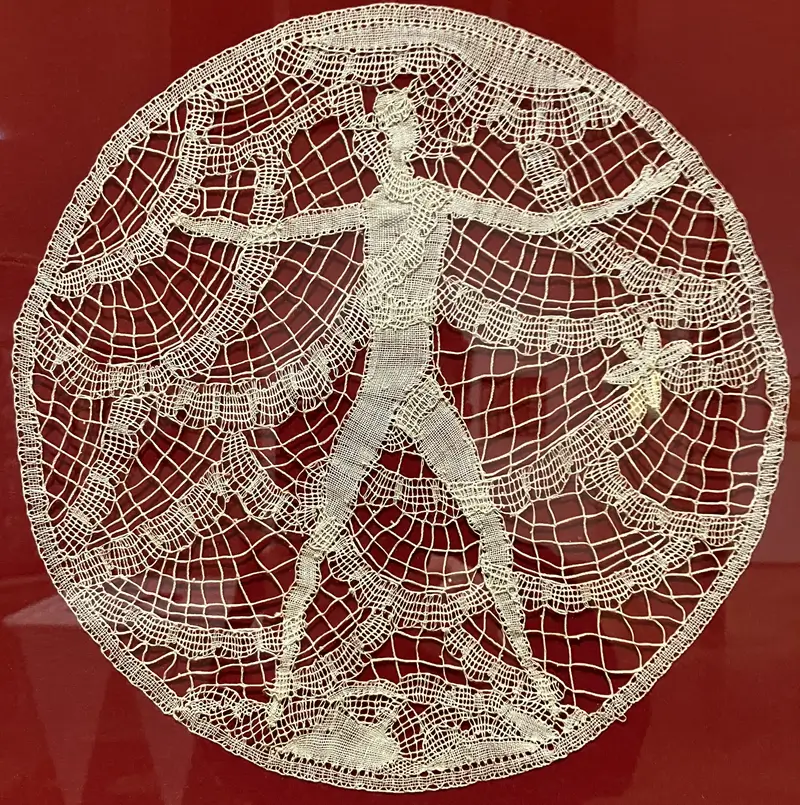
He made a radical break with the classical floral motifs of days gone by. In his works, he brought to life stylised nudes, mythological scenes featuring nymphs, and dynamic, Baroque-inspired depictions of animals.
Under Peche, lace is elevated from a mere garment embellishment to an autonomous work of art, often framed and hung on the wall like a painting [2].
Outside Vienna, too, creative resistance to the decline of the craft is emerging: in France, lace-makers from Le Puy, Issoire and Bayeux are making their mark. In Germany, Leni Matthei is making a name for herself with her innovative bobbin lace appliqués in the austere Bauhaus style [3].
Belgium and the First World War: The Birth of ‘War Lace’
Belgium took a very different path during the First World War. With the invasion of German troops, the local economy collapsed overnight. Raw materials were in short supply, exports were blocked and over 50,000 lace-makers were left with nothing. What followed was one of the most fascinating humanitarian rescue operations of the modern era: the birth of what came to be known as ‘War Lace’.
f To prevent impending mass poverty and economic collapse, the Belgian Lace Committee was formed under the patronage of Queen Elisabeth of Belgium. It joined forces with the international Commission for Relief in Belgium (CRB), led by the future US President Herbert Hoover.
Hoover pulled off a diplomatic masterstroke: he negotiated a special agreement with the warring parties, Britain and Germany. The result: high-quality yarn could be imported into Belgium despite the naval blockade – on condition that the finished lace was exported exclusively to neutral or Allied countries. Lace production became a state-protected relief programme. ‘Work, not charity’ was the motto.
When threads shape politics: The symbolism of war lace
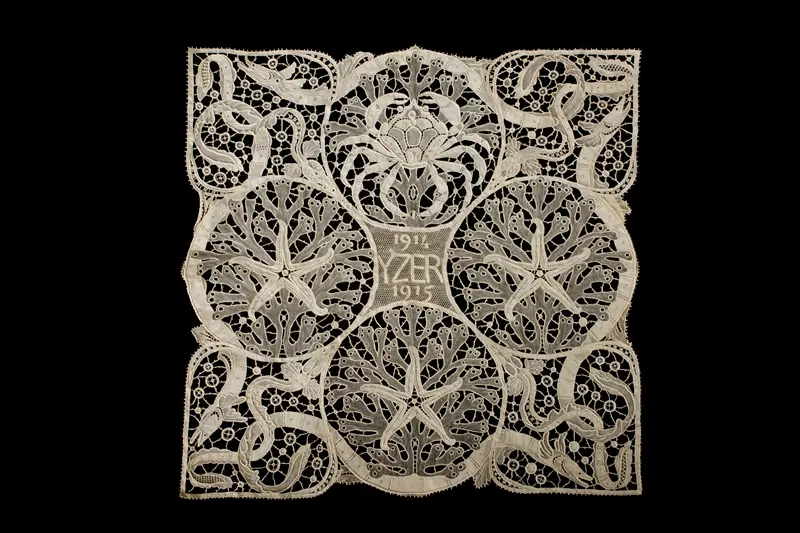
War lace marks a radical break with the classic, timeless patterns of the past. Renowned Belgian artists such as Fernand Khnopff were commissioned to create designs that captured the spirit of the times. The lace became highly political, patriotic and narrative in nature. No longer were abstract floral arrangements being created; instead, tangible messages were being woven:
• Coats of arms and lions: The blankets and collars featured the coats of arms of the Allied nations (such as the USA, France and Great Britain) or the symbols of those Belgian cities that had suffered most under the occupation (such as Ypres or Leuven).
• Expressions of gratitude: As a sign of gratitude for the food aid, American eagles, Statues of Liberty and portraits of US politicians are incorporated into the patterns.
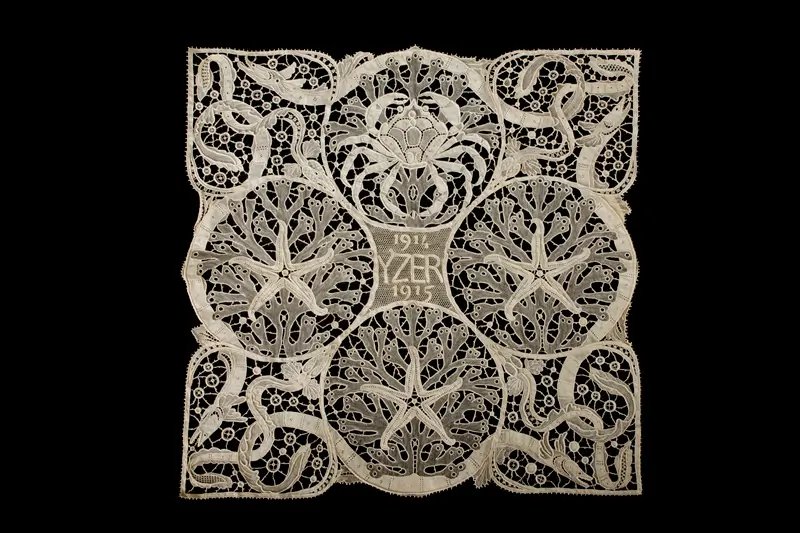
• Historical documentation: The textiles feature embroidered dates (1914–1918), inscriptions and the monograms of the Belgian royal couple, Albert and Elisabeth.
This clever ‘war marketing’ struck right at the heart of the American and British luxury markets. Wealthy women bought these precious pieces partly out of admiration for the craftsmanship, but above all as an act of political solidarity. During the war years, the project channelled millions of dollars into Belgium and ensured the survival of tens of thousands of families for years to come [4].
The globalisation of craftsmanship from the 1920s onwards
From the 1920s onwards, the production of handcrafted goods shifted dramatically. Production largely moved to the French and British colonies:
• Venetian lace is produced in Tunisia, Algeria, Madagascar and Vietnam.
• Cluny and Maltese lace mostly comes from India.
• Milanese and Brussels lace is predominantly manufactured in China [5].
The post-war era: The end of an industry and the enduring cliché
The Second World War marked the definitive end of traditional, commercial lace-making in Europe. Globalised production chains broke down, and machine-based production now took over the market entirely. From then on, this labour-intensive craft became completely detached from its former economic function. In the second half of the 20th century, lace-making became primarily a private pastime, practised for personal use in one’s spare time or as a niche hobby.
Although visionary designs such as those of the Wiener Werkstätte endure in museums as high culture, a stereotypical image has become entrenched in the collective memory of the late 20th century: Whilst knowledge of traditional needle lace has all but faded away, the laborious, time-consuming craft of bobbin lace-making is now associated in everyday life almost exclusively with the dusty, middle-class doilies on Granny’s coffee table. This once-powerful textile status symbol seems to have sunk once and for all into the insignificance of nostalgia.
Concluding Remarks
The 20th century sealed the fate of handmade lace as an economically viable status symbol and fundamentally transformed it. What began as a desperate struggle against the decline in quality brought about by mass production and the dominance of industrial goods revealed a remarkable capacity for adaptation: Craftsmanship was elevated to the status of an autonomous work of art by the avant-garde of the Wiener Werkstätte and, during the First World War, was strategically utilised as ‘War Lace’ for humanitarian aid programmes and political symbolism. Yet neither the artistic reforms nor the global outsourcing of production in the 1920s could halt the commercial decline following the Second World War. The path of the textile leads inexorably away from royal ceremonial dress and culminates in extreme polarisation: whilst masterful designs endure as high culture in museums, the practice of craftsmanship survives in the collective memory of the late 20th century almost exclusively as a dusty leisure cliché on Granny’s coffee table. With the dawn of the 21st century, however, new paths into textile modernity are emerging.
(This translation was produced using DeepL. If any errors have crept in or if any technical terms have been translated inaccurately, I would be very grateful for your feedback.)
------------------------------------------------------------------
Bibliography
[1] Kraatz 1989, pp. 151–179.
[2] Lang 2016, pp. 9–24.
[3] Kraatz 1989, pp. 151–179.
[4] See Wiertz 2022; see Cooreman & McMillan 2024; see Warlace@Kantkieper.
[5] Kraatz 1989, pp. 151–179.
---------------------------------------------------------------------