
Lace in the context of European fashion history – Part 1 - the 21st century
For five centuries, lace has been far more than just a decorative detail. It is a textile status symbol that reflects social hierarchies, political influence and the evolution of European fashion from the 16th to the 21st century. The series ‘Lace in Context’ tells the story of bobbin and needle lace.
The 21st century: Part 1 - Lace Reimagined
At the turn of the millennium, a paradigm shift took place in the perception and practice of handmade lace. On the one hand, its economic irrelevance and the image established in the late 20th century of it being a purely middle-class amateur hobby are giving way to new, materially transnational and conceptual experiments; on the other hand, however, these experiments are encountering rigid social patterns of reception and institutional barriers.
Preservation of cultural heritage and the demographic crisis
In the 21st century, the documentation and preservation of this craft lies primarily in the hands of international and national institutions. Alongside the globally active OIDFA (Organisation Internationale de la Dentelle au Fuseau et à l’Aiguille), the organisational backbone of the craft is formed by a network of specialised associations, for example:
In German-speaking countries, the Deutsche Klöppelverband e.V. (with its large membership), the regionally focused Sächsisch-Erzgebirgische Klöppelverband e.V. in the historic heartland of the Erzgebirge, the Verein Klöppel- und Spitzenkunst Österreich, and the Association of Swiss Lace-makers (VSS-FDS) are responsible for the preservation, further development and educational promotion of this cultural heritage. Internationally, this structure corresponds with organisations such as The Lace Guild (United Kingdom), which has its own museum in Stourbridge; the renowned Kantcentrum in Bruges (Belgium), a global training centre for Flemish lace; the Czech association Sdružení Krajka, centred around the Vamberk Centre; the I.O.L.I. (International Old Lacers, Inc.) and the Brooklyn Lace Guild, which has a defining influence on urban style in North America.
However, this institutional preservation work is facing a serious demographic and structural crisis, which manifests itself on three levels:
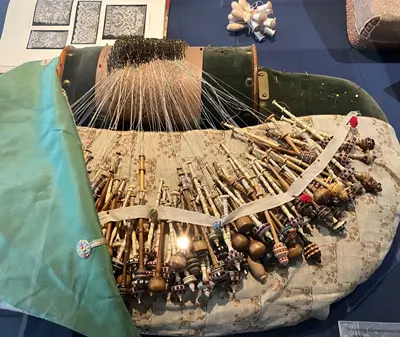
• The insurmountable time conflict: In our increasingly fast-paced society, the enormous amount of time required for bobbin lace-making and needlepoint work is at odds with today’s pace of life. Associations are finding it increasingly difficult to sustain the enthusiasm of younger people in particular. Shaped by digital media and modern leisure activities, this generation is strongly focused on quick, visible successes – so-called ‘instant gratification’.
• Institutional fragmentation: As the work of the associations is based on voluntary commitment, these institutions often find themselves understaffed. Furthermore, there is a significant number of unreported cases: numerous private bobbin lace groups, local circles or individuals operate entirely independently and are not recorded in the official directories of the national associations, making it impossible to document the current status quo comprehensively.
• The natural decline in teaching: The specialist knowledge passed down over decades is under acute threat, as the generation of experienced leading teachers and experts is increasingly retiring from active teaching or passing away due to old age. With them, an immense amount of practical, experiential knowledge is irretrievably lost.
The sociological barrier and the media stereotype
A key discourse of the 21st century concerns the socio-cultural categorisation of textile art within academic art history. For historical reasons, there is a strict distinction between the so-called ‘fine arts’ (painting, sculpture) and crafts. The latter, due to its placement within the domestic context and its historically predominantly female practitioners, is traditionally disparaged as purely craft-based, domestic and utilitarian – a stigma that continues to dog the craft to this day, despite its multifaceted history and an increasing diversification of its practitioners. Textile art is thus denied the status of an autonomous art form.
In the 21st century, institutionalised resistance is emerging against this historically entrenched marginalisation. Organisations such as the Textile Art Section of the Austrian Professional Association of Visual Artists are intervening specifically in this debate. By establishing specific awards such as the ART Award for Textile Art and promoting exhibitions within the context of contemporary visual art, the Section is breaking down this artificial hierarchy. The aim is to secure recognition of the textile medium as an independent, conceptual means of expression within the visual arts.
The reception of this art in the 21st century continues to prove controversial:
The isolation of the specialist audience: Exhibitions and presentations of modern textile and lace art generally fail to reach the wider public, but remain primarily within the closed circle of the specialist community that is already interested in the subject.
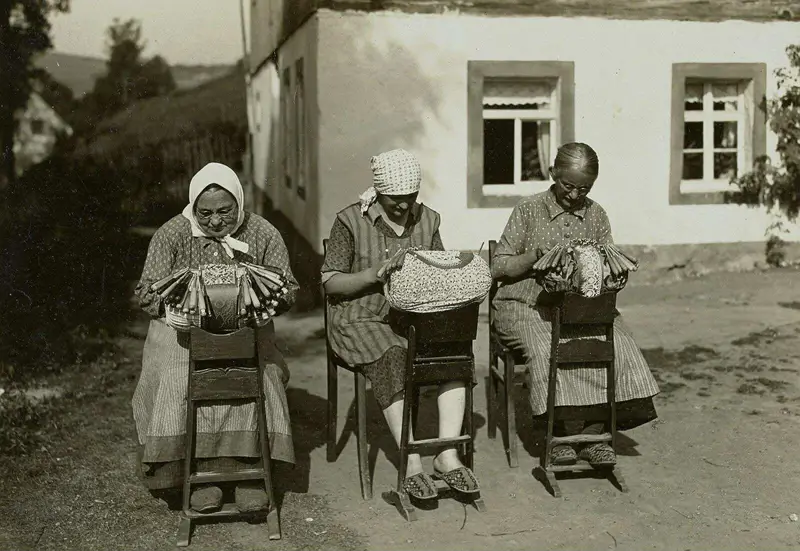
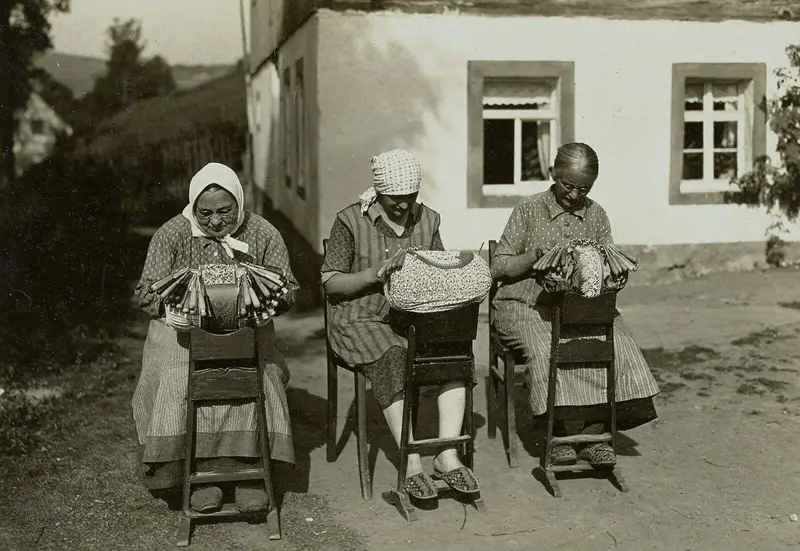
Folklorisation in the media: When bobbin lace-makers and needle lace-makers are portrayed in the mass media, this occurs almost exclusively in regional magazines or television documentaries about rural customs. This media framing reinforces the stereotypical image of a backward-looking, idyllic craft and obscures the contemporary, artistic content.
The digital subculture as a blind spot: Whilst institutions and the mass media often either academicise or folklorise the craft, a vibrant, young scene is forming on the fringes. Initiatives such as the London Lace Club demonstrate that social media can inspire a generation under 35 to take an interest in the craft. These organic, urban communities use bobbin lace-making as a progressive ‘digital detox’ and break with traditional patterns, yet they are scarcely featured in mainstream cultural reporting.
Artistic heritage or cultural renewal
The future of lace will therefore be decided at the intersection between the museum-based preservation of its glorious European fashion history and the bold move towards autonomous, new forms of expression. However, as long as broad social recognition is lacking and lace-making is portrayed in the media as a niche activity confined to club folklore, its aesthetic potential remains stifled.
You can read about how a global avant-garde is nevertheless bringing about this transformation amidst the tension between monumental street art, radical breaks with traditional materials and the revolution brought about by artificial intelligence in the second part of this series: The 21st Century: Part 2 - Lace Recoded (still in progess).
(This translation was produced using DeepL. If any errors have crept in or if any technical terms have been translated inaccurately, I would be very grateful for your feedback.)
-------------------------------------------------------------------