
Lace in the Context of European Fashion History – The 21st Century, Part 2
For five centuries, lace has been far more than just a decorative detail. It is a textile status symbol that reflects social hierarchies, political influence and the evolution of European fashion from the 16th to the 21st century. The series ‘Lace in Context’ tells the story of bobbin and needle lace.
The 21st Century: Part 2 – Lace Recoded
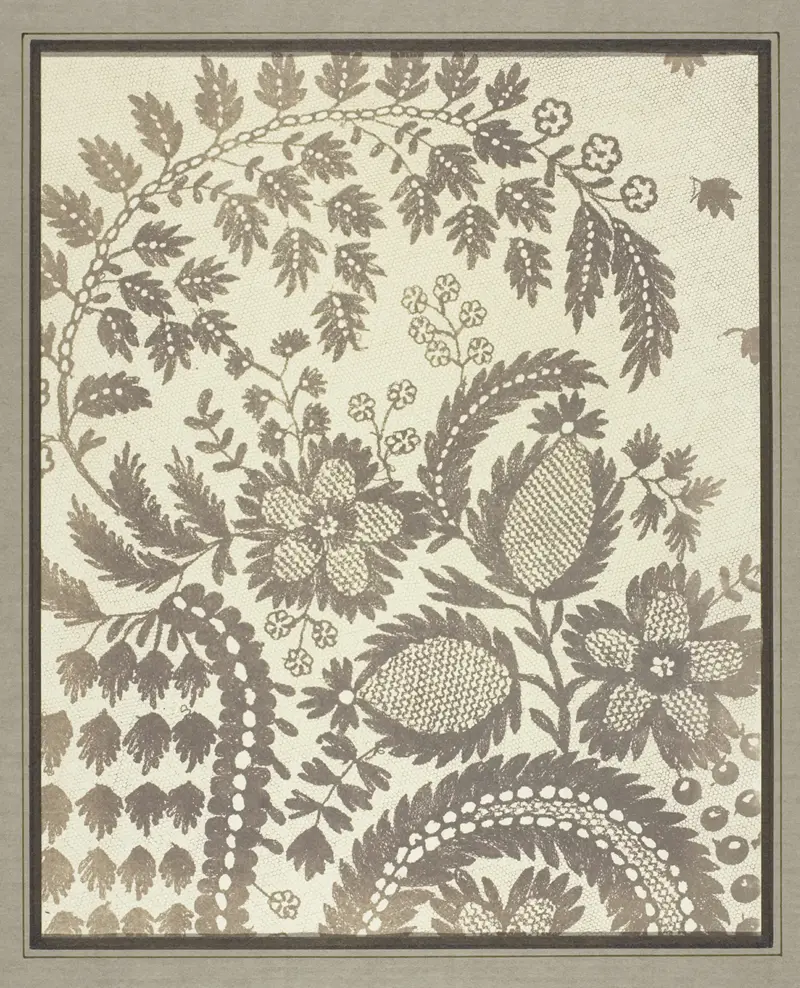
In 1842, the photography pioneer William Henry Fox Talbot placed a piece of hand-made lace directly onto a chemically coated, light-sensitive sheet of paper and exposed it to the sun. The result – a so-called photogram simply titled *Lace* – caused a sensation [1]. Talbot does not capture the textile itself, but rather reproduces on paper the interplay of light and shadow created by exposure to light. This faithful reproduction produces such a precise visual illusion that contemporary viewers mistake the flat image for a real piece of fabric rather than a piece of paper [2].
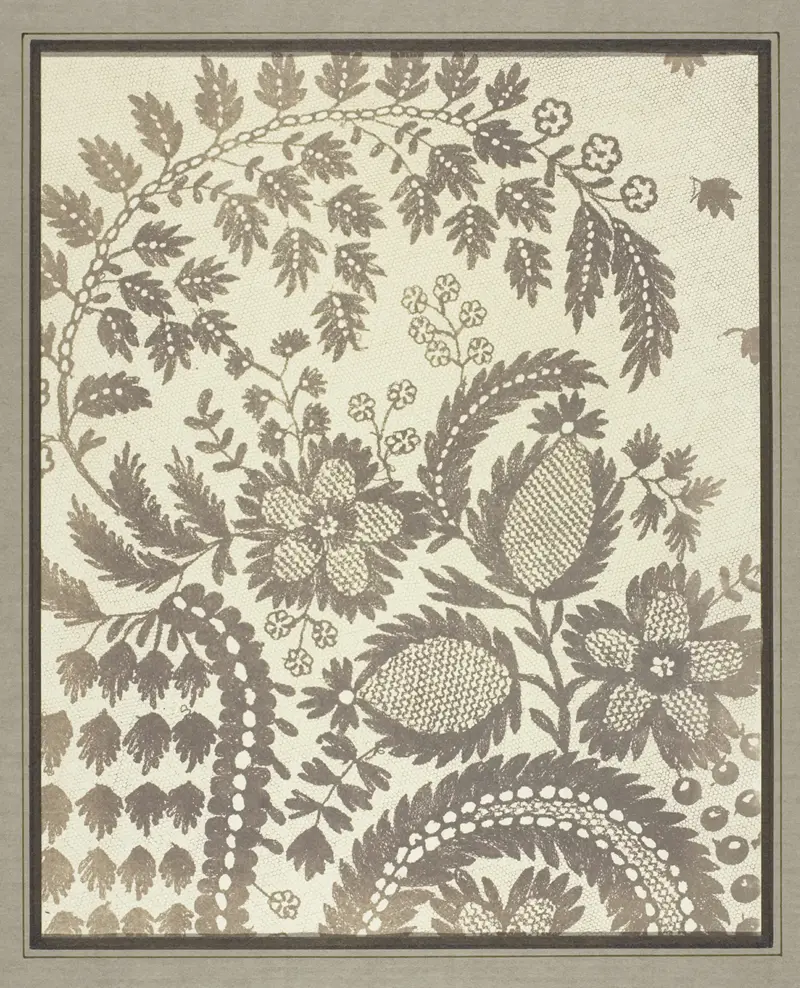
What Talbot began back then as a media-theoretical experiment at the dawn of photography foreshadows the fundamental transformation on the threshold of which, in my view, we stand today. Almost 185 years ago, Talbot already understood lace not as a conventional, decorative craft, but as a binary system of structure and void, of presence and absence. He utilised the mathematical precision of the fabric to herald a new technological age [3].
Today, in the 21st century, this circle is complete. The perception of lace operates within a fascinating field of tension: the textile medium is breaking free from its old frameworks, leaving behind the niche of traditional handicrafts with feminine connotations, and branching out in entirely new directions.
This transformation is currently manifesting itself in three parallel trends:
• Innovative preservation of tradition: The traditional bobbin lace scene is no longer confined to replicating historical patterns. Whilst it remains true to its craft heritage, it is increasingly breaking free from the constraints of functional textiles. By combining unconventional materials and techniques, it is opening up to experimental forms, three-dimensionality and optical illusions.
• The socio-cultural revival: Standing out from this is a new generation that embraces the craft as an emancipatory lifestyle. As a conscious, almost meditative act of slowing down in a hyper-digitalised world, bobbin lace-making serves here as a creative outlet and an analogue retreat.
• The conceptual avant-garde: The visual arts effect the most radical break with tradition. Whilst this movement utilises the same craft-based fundamentals, it consistently removes bobbin lace-making and needle lace-making from the context of arts and crafts. The medium is conceptualised and employed as a semantic vehicle for socio-political discourses, questions of identity or approaches critical of institutions.
Whilst the first two movements anchor the craft as a living tradition and a meditative way of life within everyday existence, the conceptual avant-garde in the visual arts is developing an entirely new art-historical framework. To me, its multidimensional approach manifests itself in the following key movements:
a) Digital code & pixel logic: The calculation of structure
In the 21st century, the centuries-old logic of the bobbin lace pattern merges with algorithmic processes and digital code structures. This movement regards the binary principle of crossing and twisting as the archetype of programming. Digital image glitches, 3D prints and mathematical continuities break down the medium and translate fleeting data streams back into the precision of software-assisted or analogue craftsmanship.
b) The liberated network: cross-border collaboration & global discourse
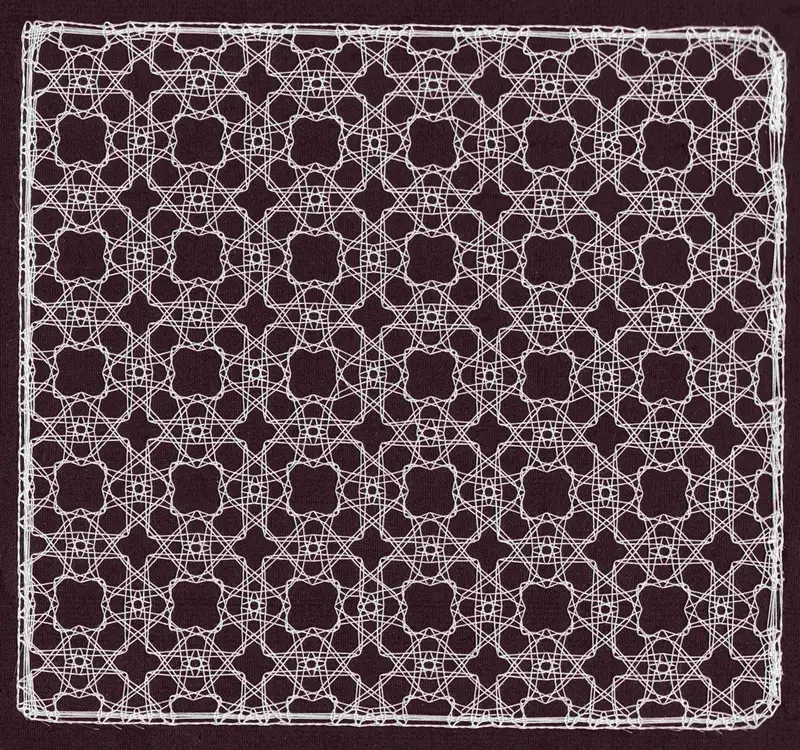
Contemporary lace breaks free from historical patterns and evolves into a tool for free, globally networked experimentation. Global networks and collaborative communities deconstruct traditional techniques to form a vibrant collective beyond the conventional boundaries of handicraft. At the same time, this movement liberates the craft from its Eurocentric niche and utilises digital platforms to make this knowledge accessible to a new generation as an emancipatory, global cultural asset.
c) Monumental interventions: When lace saves spaces and seas
Textile fabric is finally breaking free from its role as a small-scale, decorative ornament and evolving into a space-filling, three-dimensional medium at the intersection of architecture, object art and applied ecosystem conservation. The spectrum of this movement ranges from spectacular, delicate large-scale installations that imbue urban squares or museum spaces with emotional resonance, to works that enter into a direct symbiosis with natural finds. Going far beyond mere aesthetics, the openwork network also fulfils an ecological function: as a biodegradable structure in the world’s oceans, the mathematical fabric transforms into an artificial reef to actively regenerate dying coral structures and protect marine life.
d) Material transformation: The symbiosis of hardness and sculpture
The perceived fragility of lace is radically reinterpreted through its confrontation with hard industrial materials and unconventional substances. Whether cut into steel weighing several hundredweight using a plasma cutter, shaped into three-dimensional decorative architecture, or bobbin-laced into a freestanding sculpture from the finest metal wire: the medium loses its traditional textile softness and gains a monumental, sculptural and structurally autonomous presence in space.
e) Bioart & Organic Co-creation: The Growing Network
This movement breaks with the human claim to control and allows the mathematical structure of lace to merge with the biology of living plants. The network is no longer controlled exclusively by artificial means, but grows through genuine co-creation. Fine plant roots are cultivated on geometric stencils, allowing nature itself to grow along the predetermined lines of historical lace patterns. The roots act as a biological thread that weaves itself as it grows. The result is a fascinating symbiosis of human design and autonomous nature – a living, constantly changing and ephemeral organism.
f) Textile activism (craftivism) & identity politics
The lace fabric leaves the sheltered, domestic and private sphere and becomes a vocal tool of political protest, feminist liberation and decolonisation. Through the deliberate subversion of this traditionally ‘well-behaved’, femininely connoted craft and the incorporation of everyday scenes, texts or breaches of taboos, needle and bobbin lace becomes politicised. It serves contemporary artists as a powerful metaphor for social interconnections, power structures, censorship and the visibility of queer identities.
g) Narrative deconstruction: the fragment and the void
Whilst traditional lace strives for mathematical perfection and flawless symmetry, this movement celebrates the fragmentary, the deliberately unfinished and the breaking away from classical patterns in order to evoke trauma and memories. The focus shifts from the organising thread to the breaks and holes – to the void in between. The textile fabric becomes the equivalent of the human psyche and serves to visualise loss, dementia, historical amnesia or fragmented, dissolving family memories.
h) Material Mimicry & Illusionism
This category completely detaches the visual DNA and mathematical logic of the hand-knitted piece from its traditional medium – the textile thread. Whether as large-scale façade perforations in architecture, as photorealistic street art murals created with spray paint, or in the form of a delicate symbiosis of needle lace and untouched natural materials such as driftwood: lace becomes a universal, cross-disciplinary design principle comprising light, shadow and openings, creating the illusion of textile structures where none actually exist.
Preview
These eight theoretical categories are not abstract constructs – they are being brought to life by visionary artists around the world. Over the coming weeks, I will devote a separate article to each of these movements and introduce you to the artists of the global avant-garde in detail.
Concluding remarks: The autonomous network of the future
The global avant-garde demonstrates impressively that the recoding of the avant-garde in the 21st century is not a break with its history, but rather its logical, emancipated continuation. The mathematical logic that was already inherent in historical patterns finds its contemporary counterpart in artificial intelligence, in digital pixel code or in monumental ecological interventions. By freeing itself from the decorative constraints of the past, this art form has moved beyond the stage of mere handicraft and matured into an autonomous, critical art form.
Contemporary lace is not preserved by the avant-garde in a museum display case, but is thrown right into the heart of the social discourses of our time. Anyone who still confines it to the niche of club folklore is blindly overlooking one of the most dynamic, versatile and exciting media in contemporary art. The future of lace is no longer rigidly predetermined – it is being re-established in a strikingly new way within the global cosmos of the visual arts.