
The Language of Luxury: A Cultural History of Bobbin and Needle Lace
‘Clothes make the man’ – this saying still holds true today, even though dress codes and breaches of them are no longer regulated by law. Clothing shapes and creates social realities. It reflects the immediate living environment: it provides insights into living and working conditions, as well as political, economic and intellectual contexts. The self-image of an era is always expressed through its fashion.
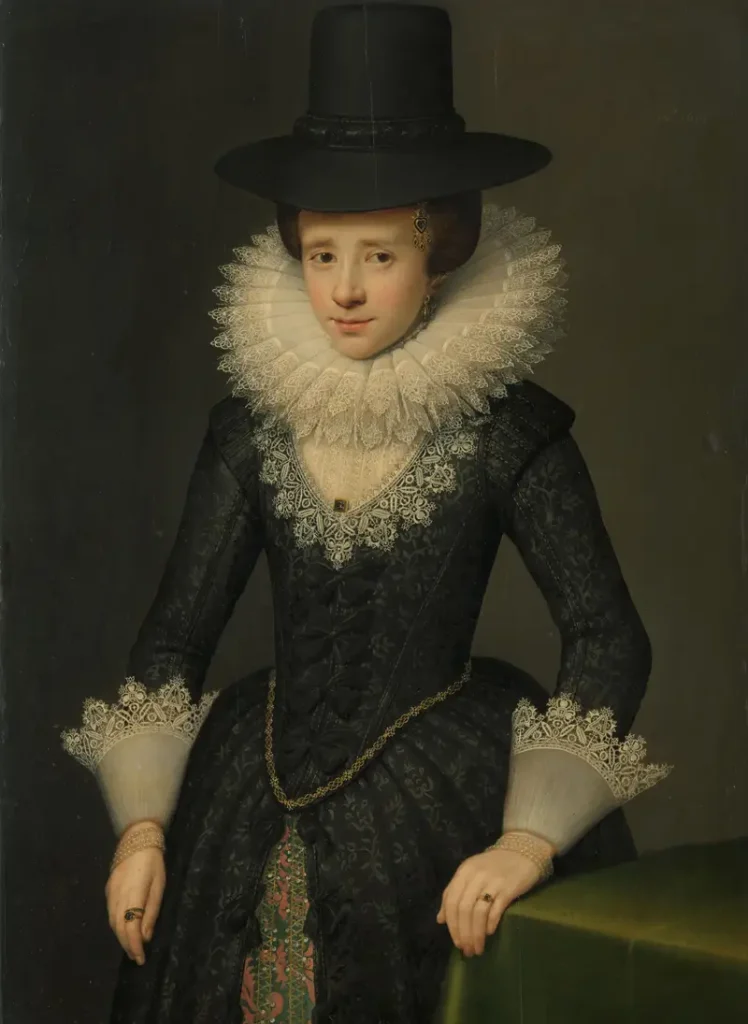
One historical turning point illustrates this clearly: the French Revolution. In keeping with the new circumstances, the clothing of the bourgeoisie was to differ radically from the pompous, courtly and absolutist fashion of the nobility. As you will see later, this also had an impact on the design of lace.
Human beings and the need for distinction
The emergence of clothing has always been accompanied by the need to adorn oneself and to set oneself apart. Even people in the Stone Age painted their bodies with colours and adorned themselves with shells or stones. Jewellery and clothing have always been an expression of human personality. They reveal the significance and status of the individual within a society.
Customs, religion, age and gender, as well as the cultural, economic and historical characteristics of each people, influence fashion. The history of fashion, in turn, is inextricably linked to technological progress – from the invention of the hand loom, through the mechanical loom, to modern synthetic fibres.
‘Lace’ – The status symbol of the upper classes
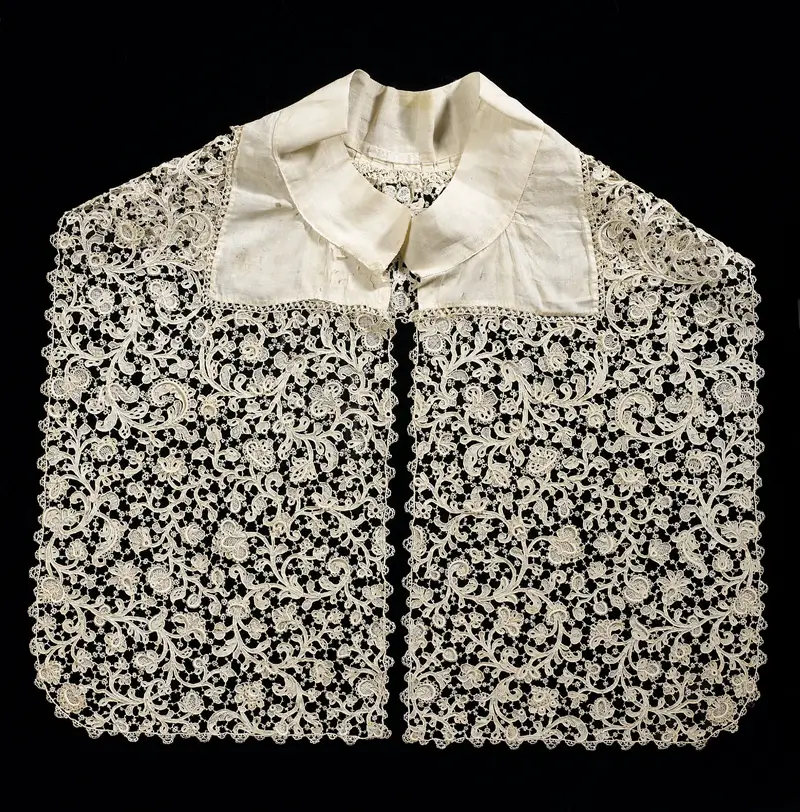
Within this context, one textile artefact occupies a truly unique position: lace. Its fascinating history spans more than 500 years – from its beginnings in the 16th century, through its glorious heyday in the 17th and 18th centuries, to the machine age around 1900, which fundamentally transformed this traditional craft.
In the 17th and 18th centuries, lace-making was far more than just a craft; it became Europe’s most important luxury industry and had a decisive influence on the continent’s cultural history. The social status of lace was undisputed: much like exquisite jewellery, it served as a clear status symbol of the upper classes, demonstrating wealth, social standing and a refined appreciation of art and taste.
Between delicacy and unrivalled excellence
Even semantically, the word ‘lace’ continues to evoke connotations of the highest quality and unrivalled excellence. We associate it with delicacy, craftsmanship, refinement and pure luxury. Émile Zola masterfully describes just how beguiling this effect was on people in the 19th century in his novel *The Ladies’ Paradise* (1883) (My own free translation):
‘But she had never seen anything like it before; her admiration held her fast on the pavement as if she were nailed there. In the background, a very expensive sash of Brussels lace, spread out like an altar cloth with both ends unfurled wide, displayed its rough whiteness; capes of Alençon lace seemed to have been thrown over as if in drapes; then, poured out in generous handfuls, lace of every kind cascaded down – Mechelen, Valenciennes, Brussels and Venetian – like a snowfall.”
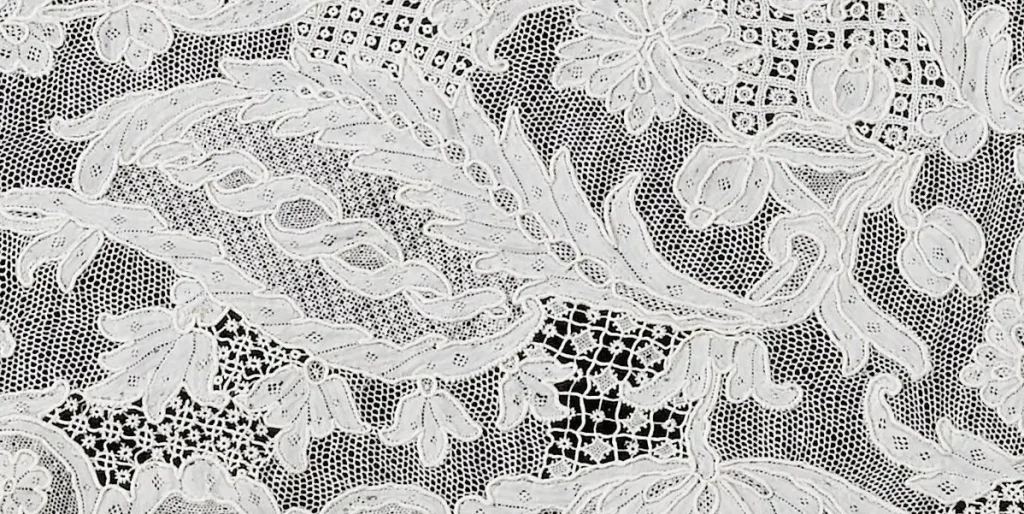
But how are these textile works of art created, which enchant the fashion world like a snowfall? And what distinguishes delicate needle lace from ornate bobbin lace? Let’s delve into the history of two techniques that are taking Europe by storm...
1. What is ‘lace’? The birth of a textile work of art
To understand the fascination of this craft, it is worth looking at the definition provided by the textile historian Friedrich Schöner [1]:
‘Lace is a two-dimensional textile object in the form of an ornament, the effect of which is based on the background shining through the gaps between the pattern shapes.’ (My own free translation).
To this day, a passionate debate often rages amongst lace enthusiasts: what counts as ‘real’ lace? Whilst purists recognise only needle-made and bobbin lace, others also include filet, crochet and knitted lace, as well as knotted forms such as macramé, occhi, Smyrna or Sol lace.
A child of the European Renaissance
However, a purely technical definition falls short, as it overlooks the historical dimension. Genuine textile lace is the product of a specific era: the European Renaissance. This was a time when humanity and the individual took centre stage in intellectual thought and were accorded a completely new status.
From a historical perspective, lace arose from a purely practical need: to secure the edge of woven fabric. It is, in the truest sense of the word, a fabric-edge embellishment that has taken on a life of its own [2]:
• Needle lace developed artistically from openwork (embroidery).
• Bobbin lace evolved from free-form netting.
From fraying to fashionable extravagance
When finely woven linen undergarments first appeared during the Renaissance, tailors were faced with a problem: this fine fabric must not fray. The warp and weft threads at the cut edges had to be either laboriously hemmed or interlaced to form fringes.
As the upper classes wished to proudly display their precious double-layered garments, this visible edge called for decorative embellishment. The sewn hem evolved into delicate needle lace; the knotting or interlacing of the threads laid the foundations for bobbin lace [3].
A purely Western cultural heritage
From the very beginning, lace has served two purposes: either as a trim to adorn the edge of a piece of fabric, or as an insert to join two pieces of fabric together. During the 16th century, this decorative element spread rapidly. Suddenly, it was adorning cuffs, opulent collars, bonnets, bed linen and handkerchiefs. Later, standalone accessories followed, such as elegant scarves, barbes, Spanish mantillas (veils), gloves, parasols and fans. From the 20th century onwards, it could be found as window decorations or Easter and Christmas decorations in the home.
The birth of lace in the strict sense can be traced back to the Renaissance: bobbin lace probably around 1525, needle lace around 1550, although the respective precursors date back even further. Bobbin lace and needle lace are inextricably linked to Western culture. Bobbin lace, in particular, remained initially confined exclusively to Christian Europe and only reached the New World much later through European emigrants and missionaries [4].
2. Needle lace: sculptures made from a single thread
The origins of needle lace (or sewn lace) lie in the shadows of Venetian workshops. It is thought that embroiderers from Venice developed the technique: they removed a certain number of weft threads from a piece of fabric and reinforced the remaining warp and weft threads with blanket stitch or buttonhole stitch. Between this delicate supporting grid, they stretched further threads, reinforced with blanket stitch, to make the work appear increasingly transparent and weightless [5].
In art history, needle lace is divided into three periods and stylistic groups:
Geometric symmetry (e.g. Reticella): early forms whose patterns fit strictly mathematically within a grid.
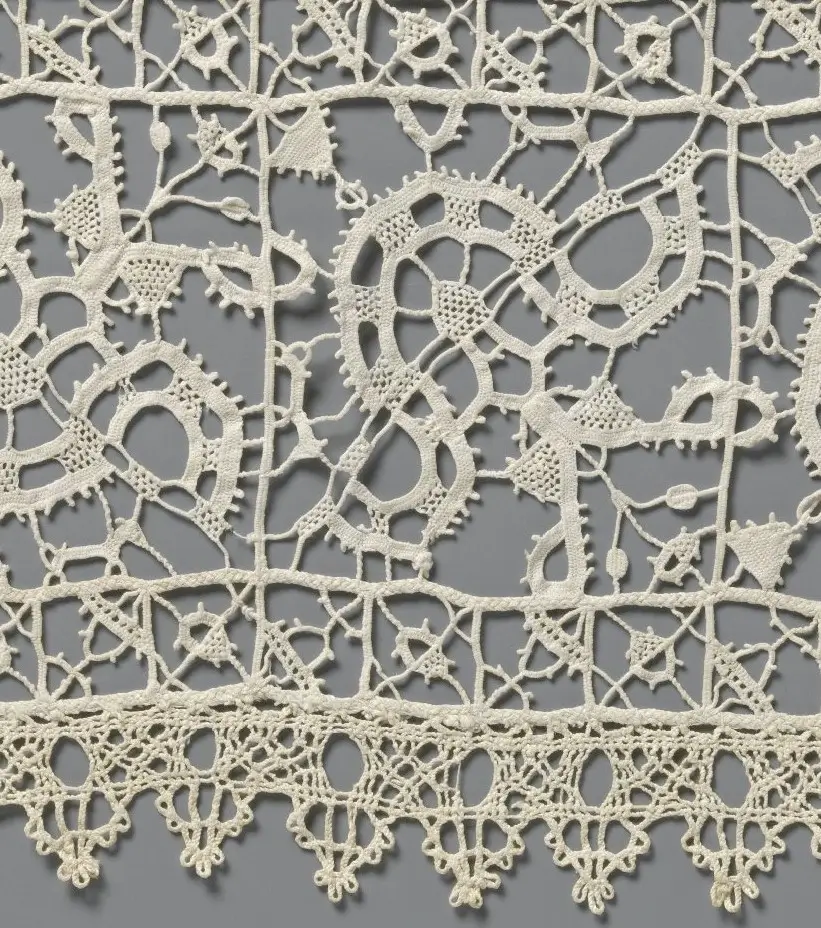
Three-dimensional Renaissance tendrils (e.g. relief lace / Point de Venise): Curved, stylised flowers and leaves, freely interconnected in space by fine rods (stems). The plain linen collar from the Rijksmuseum Amsterdam, with its symmetrical tendril pattern and varied flowers and leaves, is a wonderful example of the Point de Venise technique.
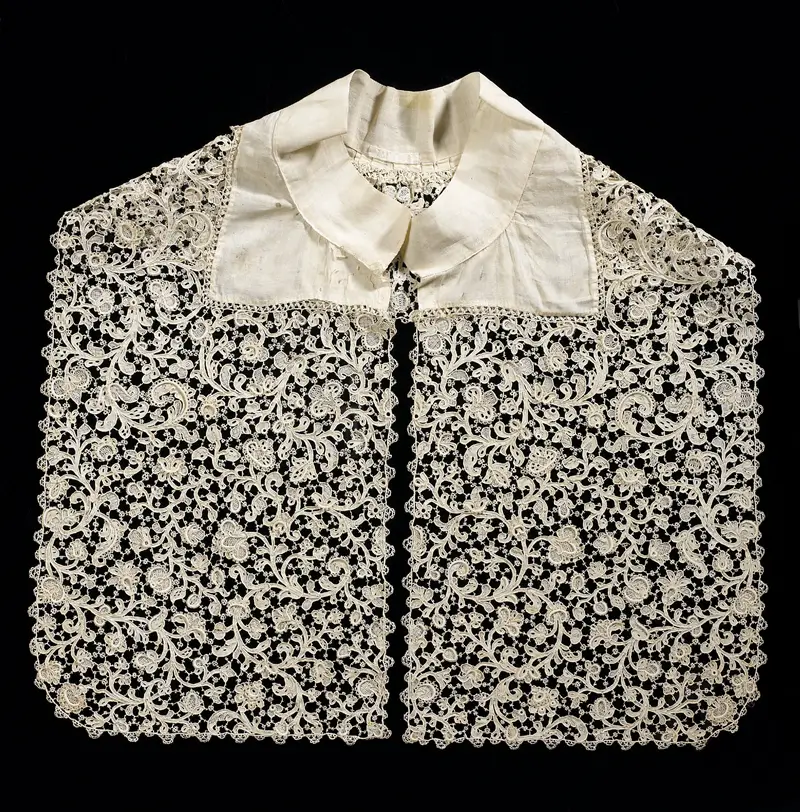
The large basic lace patterns (e.g. Point de Alençon): Baroque masterpieces in which the dense pattern stands out clearly against a separately worked, net-like background.
3. Bobbin lace: The highly complex interplay of threads
Bobbin lace is a multi-threaded interlacing pattern, the interlacing techniques of which have evolved from four-strand braiding, weaving and twisting. The tools used are a cylindrical or square bobbin, depending on the region, to which one end of the threads is secured with pins; and the bobbins, onto the upper half of which the other ends of the threads are wound. The lower part of the bobbins is the handle, which is used to interlace, cross, twist and weave the threads together (My own free translation).
This is how Tina Frauberger [6] describes the bobbin lace technique. It is derived from passementerie. The production of passementerie is a highly specialised craft that requires different techniques depending on the end product (trims, cords, ribbons, braids). To produce cords, several threads are crossed and plaited together. To prevent the countless threads from becoming tangled, weights made of lead, bone or wood are attached to the ends – and thus the wooden bobbins were born.
The ingenious transition from trimmings to genuine bobbin lace took place around 1525, almost simultaneously in Flanders (Antwerp) and Italy (Venice). The technique continued to evolve right up to the 18th century. Today, we distinguish between well over 40 types of bobbin lace, characterised by the artful use of various stitches (braid stitch, shaped stitch, linen stitch) and the resulting distinctive mesh patterns [7].
Technically, bobbin lace can be divided into five categories:
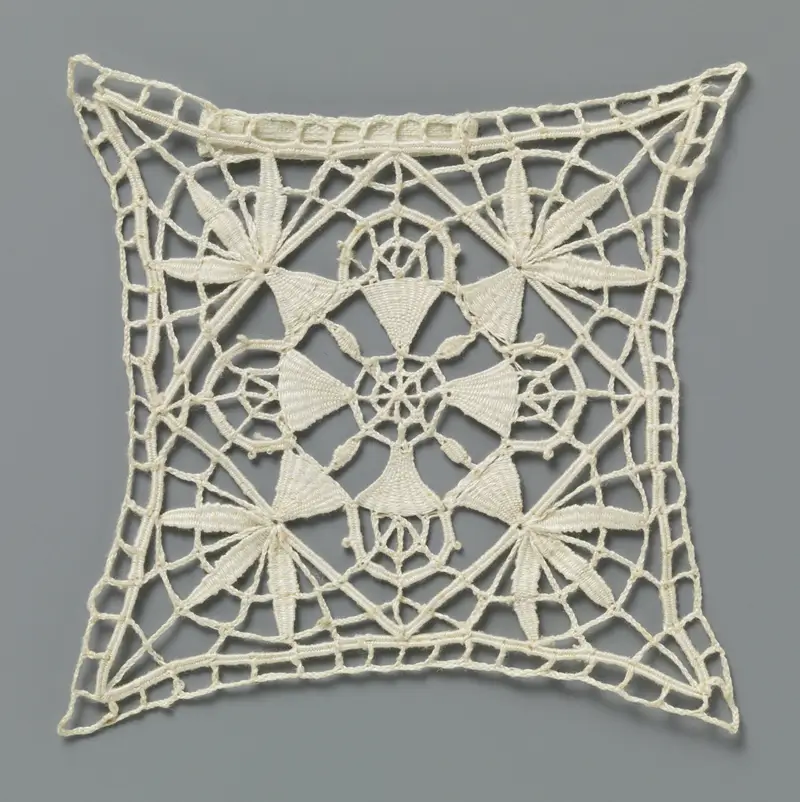
1. Braided lace
The oldest bobbin lace in history. It is worked as lace with continuous threads and four-thread braids [8].
• Examples: Cluny lace, Maltese lace, Bedfordshire lace.
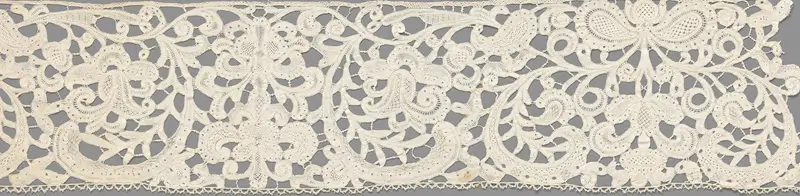
2. Ribbon lace
Developed in the first half of the 17th century. Its distinctive feature is the curved, flowing ribbons in linen weave that run throughout the entire pattern [9].
• Examples: Milanese lace, Russian ribbon lace, Austrian lace, Schneeberg lace.
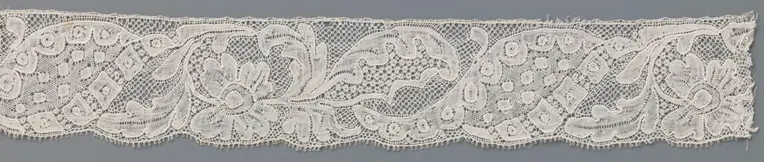
3. Lace with a mesh ground
Here, the actual bobbin lace pattern is embedded in a delicate mesh ground, which is usually incorporated at a later stage. This technique, which originated in the mid-17th century, utilises continuous or cut threads [10].
• Examples: Valenciennes, Binche, Mechelen lace, Point de Lille, Blonde, Chantilly, Flemish lace.
4. Lace with cut threads
The (in my view) pinnacle of late 17th-century lace-making: The individual motifs and flowers are bobbin-laced entirely separately and only then joined together using intricate techniques. The result is an unrivalled richness of patterns and three-dimensional depth [11].
• Examples: Brussels bobbin lace, Brussels Duchesse, Bruges Duchesse, Withof lace, Honiton, Rosaline, Chrysanthe.
5. Freehand lace
The most rustic form of folk art amongst laces. These ancient techniques were practised in rural settings entirely without a pattern chart (template) and shaped traditional regional costumes for centuries [12].
Concluding Remarks
The cultural history of lace shows that clothing acts as a mirror of social reality and a means of distinguishing oneself from others. Since the Renaissance, textile lace has held a special place in this regard: as the ‘language of luxury’, it was the ultimate status symbol of the European upper classes in the 17th and 18th centuries. Originating as a practical means of protecting fabric edges, two masterful main techniques developed: sculptural needle lace and multi-threaded bobbin lace. As a purely Western cultural heritage, their stylistic eras continue to reflect the aesthetic spirit and technological change of Europe to this day.
(This translation was produced using DeepL. If any errors have crept in or if any technical terms have been translated inaccurately, I would be very grateful for your feedback.)
------------------------------------------------------------------
Bibliography
[1] Schöner 2003, p. 8.
[2] Schuette 1981, p. 15.
[3] Ibid.
[4] Knoff 2007, p. 12.
[5] Kraatz 1989, p. 12.
[6] Frauberger 1984, p. 16.
[7] Schuette 1981, p. 49 ff.
[8] Knoff 2007, p. 66.
[9] Ibid., p. 95.
[10] Ibid., p. 129.
[11] Ibid., p. 175.
[12] Ibid., p. 200.
-------------------------------------------------------------------